

TL;DR:
- Self-catering means staying in a fully equipped property with a kitchen to prepare your own meals.
- It offers flexibility, independence, and cost savings, especially for health-conscious travelers and longer stays.
- Choosing well-equipped, centrally located accommodations enhances your experience of Brugge’s local markets and vibrant food scene.
Booking accommodation in Brugge can feel overwhelming, especially when listings throw around terms like “self-catering” without explaining what that actually means for your trip. Many travelers assume it just means a mini-fridge and a microwave. It doesn’t. Self-catering accommodation is a genuinely different style of travel, one that hands you control over your meals, your schedule, and your budget. For health-focused visitors who want fresh, colorful food without relying entirely on restaurants, understanding this distinction can make or break your Brugge experience. This guide breaks down exactly what self-catering means, how it works day-to-day, and how to choose the right setup for a vibrant, healthy stay.
Table of Contents
- Defining self-catering accommodation: What it really means
- How self-catering accommodations work: Mechanics and typical inclusions
- Comparing self-catering to other lodging: Pros, cons, and cost
- Choosing the right self-catering accommodation in Brugge
- A fresh perspective: Why self-catering in Brugge is a traveler’s secret weapon
- Ready for your Brugge self-catering adventure?
- Frequently asked questions
Key Takeaways
| Point | Details |
|---|---|
| Full kitchen freedom | Self-catering lets you prepare your own healthy meals in Brugge. |
| Major cost savings | Travelers and families often save 40-60% over hotel stays by cooking and living more independently. |
| Flexibility and local flavor | Enjoy local Belgian foods at your pace while exploring vibrant dining scenes in Brugge. |
| Choose amenities wisely | Always double-check kitchen features, location, and benefits before booking. |
Defining self-catering accommodation: What it really means
The term gets misused constantly, so let’s set the record straight. Self-catering means lodging with a full kitchen where you prepare your own meals. It’s not a hotel room with a kettle. It’s not a B&B where breakfast magically appears. It’s an apartment, cottage, holiday home, or townhouse that functions like a temporary home, giving you the tools to live independently.
The key word is fully equipped. A true self-catering property includes a kitchen, utensils, bedrooms, living areas, linens, and Wi-Fi, without any host-provided meals or daily housekeeping. You’re not a guest being served. You’re a temporary resident with real kitchen access.
Here’s what a legitimate self-catering property should include:
- A full-size oven, stovetop, and refrigerator
- Cookware, baking trays, and utensils
- Plates, glasses, mugs, and cutlery
- A dining area to eat comfortably
- Linens, towels, and basic toiletries
- Wi-Fi and utilities included in the rate
- A private living space separate from sleeping areas
What doesn’t qualify as true self-catering? A hotel room with a single-ring burner and a bar fridge. A serviced apartment where staff clean daily and meals are available on request. These are hybrids, and they operate very differently from a genuine self-catering setup.
“Self-catering is about independence. You shop, you cook, you eat on your terms. That’s the entire point.”
For health-conscious travelers, this distinction is huge. When you control the kitchen, you control what goes into your food. You can stock up on superfoods, prepare balanced meals, and avoid the calorie-heavy tourist menus that dominate many city centers. In a place as rich with local markets and fresh produce as Brugge, having a real kitchen transforms how you experience the destination.
Don’t confuse self-catering with roughing it, either. Many Brugge self-catering apartments are beautifully designed, centrally located, and fully stocked. The absence of daily service is a feature, not a flaw. It means fewer interruptions, more privacy, and a rhythm that actually suits how most people like to travel.
How self-catering accommodations work: Mechanics and typical inclusions
Understanding the concept is one thing. Knowing how it actually plays out during your stay is another. The day-to-day reality of self-catering is simpler than most people expect, but it does require a small shift in mindset.
Here’s how a typical self-catering stay unfolds:
- Arrive and settle in. You collect your keys (often via a lockbox or smart lock), walk into your space, and unpack like you would at home.
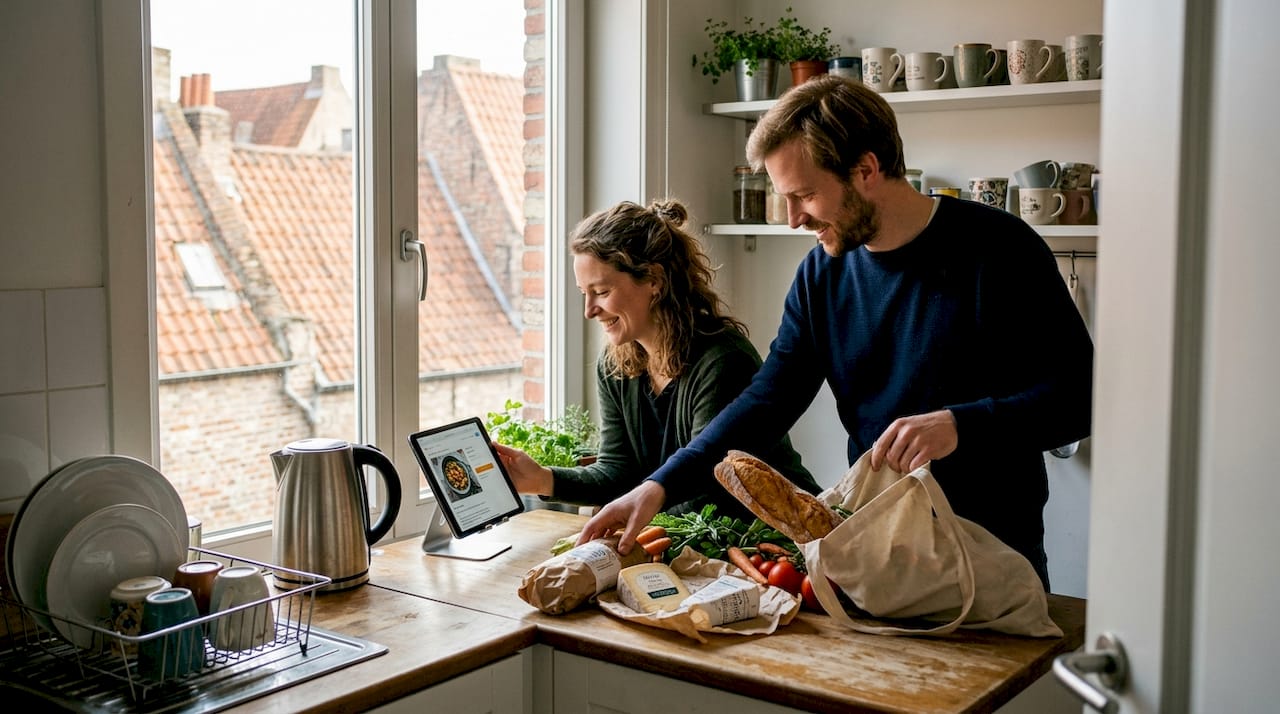
- Stock the kitchen. Head to a local market or grocery store. In Brugge, this means access to incredible fresh produce, artisan bread, local cheeses, and seasonal ingredients.
- Plan your meals. Decide which days you’ll cook and which days you’ll eat out. Most self-caterers mix both, enjoying the city’s dining scene without depending on it for every meal.
- Cook and eat on your schedule. Breakfast at 10am? Late dinner at 9pm? No one is waiting to clear your table.
- Clean up as you go. You’re responsible for dishes and tidying. Most properties include a dishwasher, which makes this painless.
- Check out. Leave the space reasonably tidy. Some properties ask for basic cleaning; others include a cleaning fee in the rate.
Guests shop, cook on their own schedule, and handle cleanup themselves. That’s the core mechanic, and it’s genuinely freeing once you get into the rhythm.
Brugge is an ideal city for this style of travel. Local markets and nearby shops make it easy to find fresh, local ingredients that fuel healthy, satisfying meals. The city’s Saturday market at ‘t Zand square is a great starting point, offering seasonal vegetables, fresh fish, and artisan products.

Pro Tip: Before booking, zoom into the listing photos and look specifically at the kitchen. Count the burners. Check for an oven. Look for counter space. A “fully equipped kitchen” claim means different things to different hosts, so visual confirmation saves disappointment.
When you combine a well-stocked self-catering kitchen with Brugge’s incredible local food scene, you get the best of both worlds: the freedom to eat healthily at home and the joy of exploring the city’s restaurants and food markets when the mood strikes.
Comparing self-catering to other lodging: Pros, cons, and cost
Self-catering sounds appealing in theory, but how does it actually compare to staying in a hotel or a traditional guesthouse? The answer depends on who you are and how you travel.
Families can save 40 to 60% on longer stays compared to hotels, simply by preparing meals at home instead of eating out three times a day. For a week-long trip with a group of four, that saving is significant.

| Feature | Self-catering | Hotel |
|—|—|—|
| Kitchen access | Full kitchen | None or limited |
| Meal flexibility | Complete control | Restaurant or room service |
| Space | Apartment or home | Single room |
| Privacy | High | Moderate |
| Daily cleaning | No | Yes |
| Cost (week stay) | Lower overall | Higher overall |
| Best for | Families, longer stays, health-focused | Short stays, business travel |
The pros of self-catering include cost savings, more space, and flexibility, while the cons center on the effort required to shop, cook, and clean. Neither option is universally better. It depends on your priorities.
Who benefits most from self-catering in Brugge?
- Health-focused travelers who want to control ingredients and avoid processed food
- Families with children who need flexible meal times and more physical space
- Groups of friends splitting costs across a shared apartment
- Longer-stay visitors exploring Brugge over a week or more
- Budget-conscious travelers who want to experience the city without restaurant bills at every meal
Who might prefer a hotel? Someone on a short two-night city break who wants zero logistical responsibility. Someone traveling for business who needs concierge services and daily housekeeping. These are valid reasons, and hotels serve them well.
The smart move for most Brugge visitors is a hybrid approach: book a self-catering apartment, cook breakfast and lunch at home using fresh local ingredients, and reserve restaurant dining for special evenings out. You get the best of both worlds without blowing your budget.
Choosing the right self-catering accommodation in Brugge
Not all self-catering listings are created equal. Some are genuinely well-equipped homes that make cooking a pleasure. Others are bare-minimum setups that will frustrate you by day two. Here’s how to tell the difference before you book.
Start by verifying that the kitchen is truly fully equipped, because the details vary widely between properties. Some hybrids now include grocery delivery partnerships, which can be a genuine bonus for health-focused travelers who want to pre-stock the fridge before arrival.
Central Brugge apartments often sit within walking distance of fresh food markets, making it easy to shop daily for local, seasonal produce. Location matters as much as the kitchen itself.
| Feature to check | Why it matters |
|---|---|
| Oven and full stovetop | Essential for real cooking |
| Refrigerator size | Matters for longer stays |
| Cookware quality | Affects meal prep experience |
| Proximity to markets | Determines fresh food access |
| Laundry facilities | Critical for stays over 5 days |
| Parking availability | Important if you’re driving |
| Food storage space | Pantry or cupboard space for dry goods |
Here’s what to look for when browsing listings:
- Photos that show the actual kitchen, not just the living room
- Specific mentions of appliances (oven, dishwasher, coffee maker)
- Reviews that mention cooking or grocery shopping
- Proximity to Brugge’s markets and supermarkets
- Clear policies on cleaning and checkout expectations
Pro Tip: For stays longer than five days, confirm whether laundry facilities are in-unit or shared, and check food storage space. Running out of pantry room or having to haul laundry to a laundromat are the kinds of friction points that quietly ruin a trip.
Trends in 2026 show a growing number of Brugge properties offering optional add-ons like grocery delivery or curated local food boxes. These hybrid models are worth exploring if you want the convenience of a hotel with the freedom of self-catering.
A fresh perspective: Why self-catering in Brugge is a traveler’s secret weapon
Most travel advice treats self-catering as a budget hack. Save money, cook your own pasta, done. But that framing misses the real value entirely.
Self-catering in Brugge is actually one of the most immersive ways to experience the city’s food culture. When you shop at a local market, you’re not a tourist buying a souvenir. You’re participating in daily life. You’re choosing seasonal vegetables, talking to vendors, and making decisions about what to eat based on what’s fresh that morning. That’s a fundamentally different relationship with a place.
For health-focused travelers, this matters even more. You’re not at the mercy of restaurant menus that may or may not accommodate your preferences. You can prepare vibrant, nutrient-rich meals that genuinely fuel your days of exploring Brugge’s canals, architecture, and culture. And when you do eat out, it’s a deliberate choice, a celebration, not a necessity.
The customizability is what most people overlook. Every self-catering trip becomes uniquely yours. Your grocery list, your meal times, your balance of cooking at home versus dining out. No two stays look the same, and that’s exactly the point.
Ready for your Brugge self-catering adventure?
Planning a self-catering stay in Brugge is only half the equation. The other half is knowing where to find food that genuinely excites you, whether you’re cooking at home or looking for something vibrant and ready to enjoy.

At Wild Foodz by Hotel Entree, we prepare fresh bowls, salads, wraps, and specialty drinks daily using superfoods and colorful, nutrient-packed ingredients. Everything is made to be visually stunning and genuinely nourishing. Whether you’re grabbing a takeaway between market runs or ordering delivery via Deliveroo, UberEats, or Takeaway.com, we fit seamlessly into your self-catering lifestyle. This February 2026, we’re also featuring Red Velvet Heart Waffles for Valentine’s Day. Explore self-catering options in Brugge and discover how we can make your stay even more delicious.
Frequently asked questions
What does self-catering mean in Brugge?
Self-catering in Brugge means booking an apartment, townhouse, or holiday home with a full kitchen so you can prepare your own meals using local ingredients. Brugge properties often sit near local markets, making fresh food shopping easy and enjoyable.
What is usually included in a self-catering property?
You can expect appliances, cookware, linens, towels, Wi-Fi, and utilities, but not meals or daily cleaning. A self-catering property includes a private kitchen, living and dining areas, and linens, with no meal service provided.
How can self-catering save money for travelers?
Families or groups can save 40 to 60% on food and lodging compared to hotels, especially on week-long trips where eating out for every meal adds up quickly.
Are there any downsides to self-catering?
You’ll need to shop, cook, and clean for yourself, and some properties may lack daily housekeeping or easy parking. The effort of cooking and grocery logistics is the main trade-off, though most travelers find it manageable and even enjoyable.
Leave a Reply