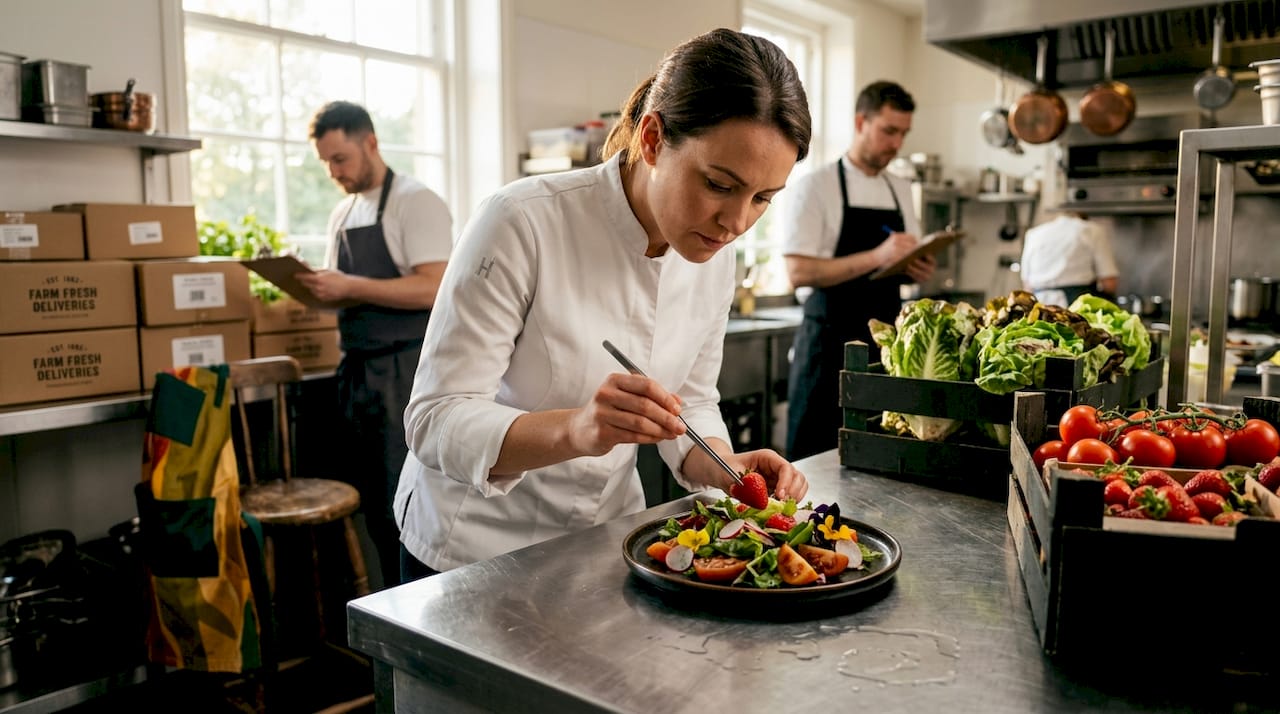


TL;DR:
- Fresh food significantly influences guest satisfaction, perceived value, and repeat behavior in hospitality. Implementing real-time shelf-life tracking and guest participation strategies enhances freshness and builds brand loyalty. Prioritizing local sourcing, staff training, and seasonal menus creates a competitive edge rooted in freshness and authenticity.
Fresh food is not a garnish on the broader hospitality experience. It is, according to recent research, one of the most statistically significant drivers of guest satisfaction and return behavior. Yet most hospitality operations treat freshness as a baseline expectation rather than a strategic lever. The role of fresh food in hospitality extends well beyond flavor: it shapes perceived value, builds brand trust, fuels operational efficiency, and directly influences whether guests come back. This article unpacks all of that, with practical frameworks you can apply and a look at how Wildfoodzbyhotelentree is putting these principles to work.
Table of Contents
- Key takeaways
- How freshness shapes guest satisfaction and perceived value
- Managing freshness as an operational system
- Guest engagement and sustainable fresh food practices
- Business advantages of a freshness-focused menu
- Red velvet waffles: a fresh food case study
- My honest take on freshness in hospitality
- Discover Wildfoodzbyhotelentree’s fresh approach
- FAQ
Key takeaways
| Point | Details |
|---|---|
| Freshness drives satisfaction scores | Freshness quality scores a beta of 0.32 in predicting guest satisfaction, making it one of the top measurable food attributes. |
| Perceived value is the link | Service quality and fresh food quality influence guest behavior through perceived value, not just taste alone. |
| Operational rigor prevents freshness drift | Quantifiable KPIs, cold-chain monitoring, and real-time shelf-life data are what separate consistent kitchens from inconsistent ones. |
| Guest participation amplifies impact | Giving guests a role in sustainability and food choices increases their willingness to pay and overall satisfaction. |
| Gastronomic focus pays off financially | Hotels with a strong gastronomic orientation show measurable financial outperformance compared to those treating food as secondary. |
How freshness shapes guest satisfaction and perceived value
Most hospitality operators know that bad food hurts reviews. Fewer realize just how much good fresh food improves quantifiable outcomes. Research published in 2026 found that freshness quality significantly predicts customer satisfaction, with a beta coefficient of 0.32, and that customer satisfaction in turn predicts behavioral intention at 0.45. That second number matters because behavioral intention captures real business outcomes: repeat visits, word-of-mouth referrals, and online recommendations.
What is happening mechanically is this: freshness does not act alone. It feeds into a guest’s perception of overall value, which then shapes satisfaction, which drives future behavior. Service quality operates the same way, with service quality influencing perceived value at a beta of 0.34. The two reinforce each other. A beautifully plated fresh bowl delivered by an attentive server creates a compounding effect that neither element achieves on its own.
There is a cultural authenticity dimension here that most operators undervalue. When fresh ingredients reflect regional identity or tell a story about where they came from, guests register them as more unique and more worth paying for. That uniqueness perception is part of what separates a memorable dining experience from a forgettable one.
- Health-supportive food quality scores a beta of 0.282 in predicting satisfaction in hospitality dining contexts
- Service quality contributes even more strongly at beta 0.472, underscoring that fresh food and delivery work together
- Guests rate freshness consistently as one of the top quality attributes across dining formats
Pro Tip: If your operation tracks satisfaction scores, cross-reference them with the days or shifts when produce deliveries are newest. The correlation often surprises operators who assumed ambiance or staffing was the primary variable.
Managing freshness as an operational system
Here is where most hospitality kitchens leak value: they buy fresh ingredients but lose freshness before service. Freshness is not a purchasing decision. It is a supply-chain discipline that spans receiving, storage, prep, and plating.

The most sophisticated operators now treat freshness as a measurable remaining shelf-life figure, updated in near-real time. Digital twin systems combining temperature sensor data with microbial kinetics models can predict how much usable life a batch of produce or protein has left, allowing kitchens to prioritize inventory routing using FEFO (first-expired, first-out) logic rather than FIFO alone. This is a meaningful operational shift.
Freshness failures almost always occur in the last mile: between receiving dock and the plate. That is where temperature abuse, improper storage, and inconsistent rotation cause the most damage. Targeting that window with monitoring and decision support tools cuts spoilage and protects the guest experience simultaneously.
| Freshness management tool | Primary benefit | Key metric |
|---|---|---|
| Cold-chain temperature logging | Prevents spoilage in transit and storage | Time above threshold |
| FEFO inventory rotation | Reduces waste, protects quality | Shelf-life days remaining |
| Digital twin shelf-life forecasting | Real-time decision support for routing | Predicted remaining life |
| Freshness signaling labels | Guest-facing transparency and trust | Label status at point of sale |
On the transparency side, time-temperature monitoring labels like the Freshtag system give guests and staff visible confirmation of a product’s freshness status throughout its journey. In seafood and perishable protein contexts especially, these labels reduce quality disputes and noticeably improve guest confidence.

Quantifiable freshness KPI targets are what prevent freshness from drifting across shifts and vendors. Freshness is classified as a high-performance but low-attention attribute in performance analytics, meaning it scores high in importance but often gets monitored less rigorously than cost or throughput metrics.
Pro Tip: Set a freshness KPI for each major ingredient category: a target remaining shelf-life percentage at time of service, not just at receiving. Then review it weekly across shifts to catch drift before guests do.
Guest engagement and sustainable fresh food practices
Guest psychology around fresh food is more sophisticated than most menus acknowledge. Research on the “illusion of control” effect in sustainable hotel practices shows that when guests are given meaningful choices around food and sustainability, their satisfaction increases and so does their willingness to pay. The mechanism is participation: guests who feel they influenced an outcome value that outcome more.
Practically, this means menu and buffet design that surfaces choices rather than hiding them. Letting guests select portion sizes to minimize waste, choose from clearly labeled local or seasonal options, or participate in a build-your-own format all activate this effect. The guest feels like a co-creator rather than a passive recipient.
Sustainability dimensions of fresh food, including local sourcing, seasonal alignment, and waste transparency, consistently show a positive influence on perceived value and behavioral intentions. But those benefits only materialize when guests know about them. If your kitchen is sourcing from local farms or rotating a seasonal menu, say so.
- Buffet formats that allow guest-directed portioning reduce waste and increase satisfaction simultaneously
- Clearly labeled seasonal or locally sourced items strengthen the perceived authenticity of fresh produce in dining contexts
- Framing sustainability participation as guest choice, not policy, dramatically improves its reception
Pro Tip: A single well-placed menu note, such as “Today’s greens harvested this morning from [farm name],” does more for perceived value than a lengthy sustainability statement buried in a brochure.
Business advantages of a freshness-focused menu
The financial case for prioritizing fresh food in hospitality is no longer anecdotal. Research published in 2026 found that gastronomic orientation correlates with financial performance at a beta of 0.558, which is an unusually strong relationship in hospitality research. Hotels and restaurants that treat food and beverage as a strategic differentiator, rather than a cost center, consistently outperform those that do not.
Here is what a genuine freshness focus looks like in practice across the competitive spectrum:
- Menu innovation grounded in seasonal ingredients. Rotating menus built around what is available fresh locally creates both culinary interest and a built-in story. Guests read novelty as quality.
- Local and regional sourcing partnerships. Properties like Four Seasons and Ritz-Carlton have formalized local farm partnerships and root-to-stem cooking programs that give them both fresh ingredient supply and a guest-facing traceability narrative.
- Staff training as infrastructure. The biggest barrier to fresh food gastronomy is not sourcing. It is execution. Investing in staff training and kitchen culture is what determines whether fresh ingredients actually reach the plate at their best.
- Honest sourcing evaluation. Local sourcing benefits depend on system factors, not just proximity. Lead times, cold-chain handling, and harvest-to-prep timing matter more than the distance between a farm and your kitchen.
The fresh food trends in restaurants driving the most growth in 2026 share a common structure: they combine visible freshness with a story guests can repeat to friends. That combination is what turns a meal into a memory and a memory into a referral.
Red velvet waffles: a fresh food case study
Wildfoodzbyhotelentree’s Red Velvet Heart Waffles, currently featured through February 2026 for Valentine’s Day, are a useful teaching example for hospitality professionals. They demonstrate what happens when freshness, culinary creativity, and visual appeal are treated as a unified strategy rather than separate concerns.
- Every waffle is prepared fresh daily, not pre-batched, which preserves texture and flavor integrity at service
- The vibrant red color and heart format create strong visual contrast that performs well in social sharing, extending the brand’s reach organically
- Premium fresh ingredients in the batter produce a sensory experience that justifies a higher perceived value and price point
- The seasonal, limited-run format creates urgency and return visits from guests who want to experience the item before it cycles off the menu
Pro Tip: Limited-time fresh offerings work best when the freshness of the ingredients is part of the story. Tell guests what makes this version different from something they could make at home. Specificity builds credibility.
The Red Velvet Heart Waffles also illustrate how a single vibrant dining experience item can anchor brand identity across a whole season. For Wildfoodzbyhotelentree, it is not just a Valentine’s promotion. It is a demonstration of what the brand does consistently: fresh, colorful, Instagram-worthy food prepared with care and served with flexibility.
My honest take on freshness in hospitality
I’ve spent years watching hospitality operations chase the wrong variables. Operators obsess over plating aesthetics or menu length, and freshness quietly degrades because no one built a system to protect it.
What I’ve learned is that freshness is operationally invisible until it fails. When it works, guests feel it without naming it. When it fails, they name it immediately in a review. That asymmetry means most kitchens underinvest in freshness protection relative to its actual impact on reputation.
The technology is now genuinely useful. Real-time shelf-life forecasting is not science fiction. It is a practical tool that mid-scale hospitality operations can access and deploy. What I’ve found is that the biggest barrier is not cost. It is the organizational habit of treating freshness as someone else’s job, split between purchasing, storage, and service without clear ownership.
Guest participation in fresh food decisions is the other thing I think operators consistently underestimate. Guests who feel they chose the fresh option actively defend their experience. They become advocates. That is worth more than any marketing spend I’ve seen in this industry.
Cultural authenticity tied to fresh, local ingredients is where I think the next real differentiation happens. Guests are increasingly sophisticated about where food comes from. Meeting that sophistication with genuine sourcing stories, not marketing copy, is what builds lasting loyalty.
— Mawghan
Discover Wildfoodzbyhotelentree’s fresh approach
If the frameworks in this article sparked ideas about how your operation could do freshness better, seeing it executed at a high level is the fastest way to pressure-test your thinking. Wildfoodzbyhotelentree builds every menu item around fresh, daily-prepared ingredients with no shortcuts on quality.

The Red Velvet Heart Waffles are a perfect entry point. They capture everything the brand stands for: premium fresh ingredients, striking visual presentation, and a guest experience that travels well on social media. Whether you are exploring fresh bowl formats, superfood-forward salads, or seasonal specialty items for your own operation, Wild Foodz by Hotel Entree offers a real-world model of how fresh food and hospitality excellence combine. Delivery is available through Deliveroo, UberEats, and Takeaway.com, with self-delivery within a 20-mile radius.
FAQ
How does fresh food quality directly impact guest satisfaction?
Freshness quality predicts customer satisfaction at a beta of 0.32 in hospitality research, with satisfaction then driving behavioral intentions like return visits and recommendations at a beta of 0.45.
What is the best way to maintain freshness consistency across kitchen shifts?
Set measurable freshness KPIs for each ingredient category, implement FEFO rotation, and use temperature monitoring logs to catch cold-chain issues before they reach the plate.
Does local sourcing always guarantee fresher ingredients?
Not automatically. Local sourcing benefits depend on harvest-to-prep timing, cold-chain handling, and lead times, not just geographic proximity to the kitchen.
Why do guests respond so strongly to seasonal menu items?
Seasonal and limited-run items signal freshness and scarcity simultaneously, which increases perceived value. When guests understand an item is available for a short time using peak-season ingredients, they assign it higher quality scores.
How does guest participation in food choices improve the hospitality experience?
Research on the illusion of control shows that guests who feel they influenced food and sustainability decisions report higher satisfaction and stronger willingness to pay than those who received identical choices passively.
Leave a Reply