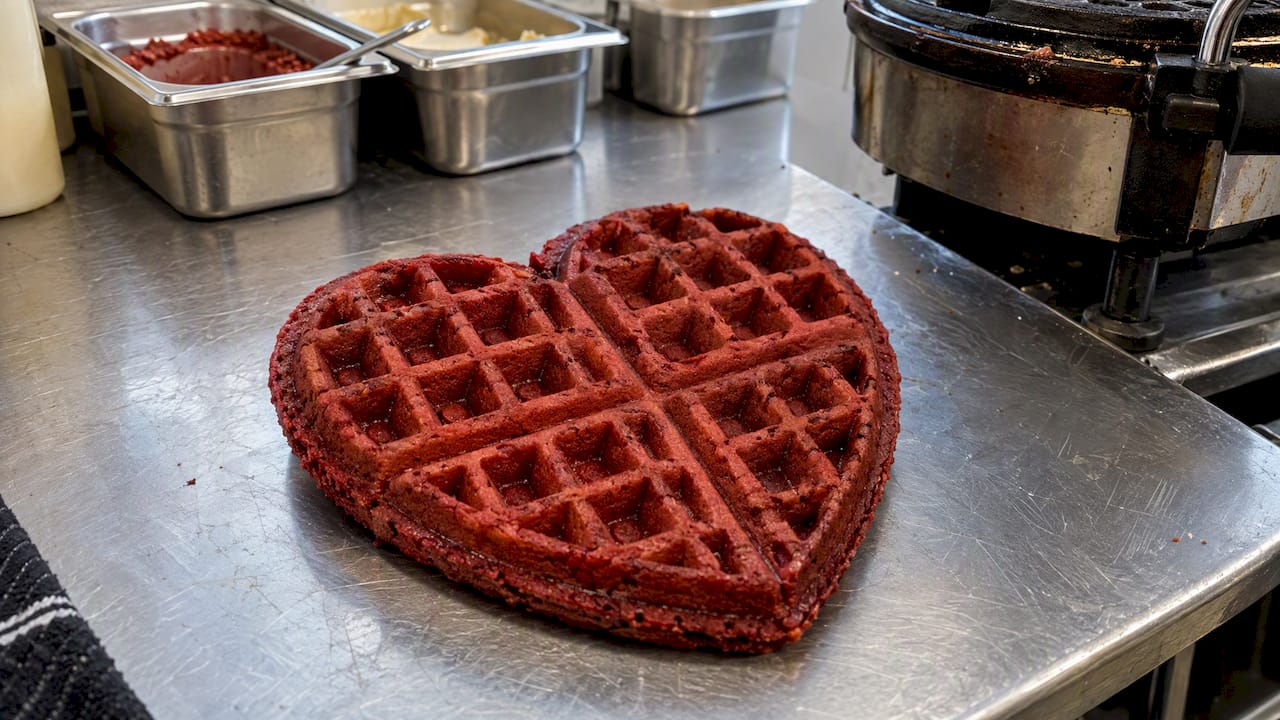


In Belgium, 14 allergens must be declared whenever they are in a food: gluten cereals, crustaceans, eggs, fish, peanuts, soy, milk, tree nuts, celery, mustard, sesame, sulfites, lupin and molluscs. This guide explains what each one means on a plate, what a Belgian takeaway has to tell you before you pay, and how to check a dessert like a red velvet waffle without guessing.
We wrote it from the counter side. At Wild Foodz by Hotel Entree in Bruges, we prepare bowls, salads, wraps, drinks and a seasonal red velvet heart waffle, and the most useful thing a customer with an allergy can do is ask the right question early.
TL;DR
- Belgium follows the EU list of 14 allergens, and each must be declared when it is used in a food, including in modified form.
- For food sold without a package, such as takeaway, the information must be available before you buy, in writing or, under conditions, orally.
- A waffle batter can bring gluten, eggs and milk, and toppings or fillings can add nuts, soy or sesame. Ask about the exact waffle, not waffles in general.
- Taking an ingredient off the plate does not always make a dish safe, because traces can remain.
- If the answer is unclear, do not eat it. That is the official advice.
Table of Contents
- The 14 allergens Belgium requires you to be told about
- Allergy or intolerance: why the difference matters when you order
- What a Belgian takeaway must tell you before you pay
- Waffles: where the allergens actually sit
- Our red velvet heart waffle: how to check it
- Cross-contact: the risk that is not on the ingredient list
- Our perspective on allergens at the counter
- Order from us, with your allergy in the message
- A short checklist for any takeaway in Belgium
- FAQ
- Sources
The 14 allergens Belgium requires you to be told about
The Federal Public Service Health lists the substances that must be declared in Belgium: cereals containing gluten, crustaceans, eggs, fish, peanuts, soy, milk (including lactose), tree nuts, celery, mustard, sesame, sulfur dioxide and sulfites, lupin and molluscs. Sulfites only count above a threshold of 10 mg/kg or 10 mg/L of total SO₂ in the food as ready to eat. The same page says these substances must be declared even when they are present in modified form.
The European Food Safety Authority confirms that EU law requires these 14 allergens to be indicated when they are used as ingredients. So the list is the same whether you buy in Bruges, Ghent or Lyon.
Here is what each one tends to look like in real food, so you know where to look:
| Allergen | Where it often hides |
|---|---|
| Gluten cereals (wheat, rye, barley, oats) | Bread, wraps, batter, pastry, cakes, some sauces |
| Crustaceans and molluscs | Seafood dishes, some stocks and spreads |
| Eggs | Cakes, pastries, mayonnaise-style sauces, egg-glazed items |
| Fish | Dressings, some sauces, seafood dishes |
| Peanuts and tree nuts | Toppings, spreads, granola, pesto, nut milks |
| Soy | Tofu, tempeh, soy milk, many plant-based products |
| Milk | Butter, cream, yogurt, cheese, chocolate, glazes |
| Celery, mustard, sesame | Dressings, spice mixes, tahini, seed toppings |
| Lupin | Some flours and baked goods |
| Sulfites | Dried fruit, wine, some preserved products |
One point from the Belgian food safety agency is easy to miss. According to the FASFC allergen FAQ, the legally listed allergens are the ones in the food-information rules, but other foods can also cause allergy or intolerance even if they are not among the 14. If you react to kiwi, buckwheat or pine nuts, the law will not necessarily flag them for you, so you need to ask.
Allergy or intolerance: why the difference matters when you order
A food allergy is an adverse immune response. NICE lists milk, eggs, soy, wheat, peanuts, tree nuts, fish and shellfish among the most common triggers, and separates allergy from food intolerance, which does not involve the immune system.
The FASFC makes the same distinction. In its 2025 FAQ, an allergen is a food component, usually a protein, that can trigger an immune reaction, and even a small amount can cause a severe reaction in some allergic people. Intolerance can produce symptoms that look similar, but it does not start in the immune system.
In practice, say which one you have when you order. “I have a milk allergy” and “I avoid lactose” lead to different answers from the kitchen. If you are unsure which applies to you, that is a question for your doctor or an allergist, not for a takeaway counter.
What a Belgian takeaway must tell you before you pay
Prepacked food carries its allergens on the label. The Federal Public Service Health says they must appear in the ingredients list and stand out visually, for example in bold, in a different color or in capitals.
Food prepared fresh and handed to you in a box has no such label, so a different rule applies. Under the Royal Decree of 17 July 2014, allergen information for non-prepacked food must be clearly available before purchase, on a physical or electronic medium at the place of sale, and refer to the relevant substances from Annex II of the EU regulation. A separate notice is not required when the written name of the dish already makes the allergen obvious.
The same decree allows oral information on request, but only under conditions: trained staff, internal procedures, and a notice that directs customers to the information or to a staff member.
What this means for you:
- You do not have to hunt for the information after paying. It should be available beforehand.
- A good takeaway shows it on a menu, a sheet or a screen, or has a visible sign telling you to ask.
- For online orders, look for the allergen information before you confirm the basket, not on the receipt.
We go through this from the ordering side in our guide on 14 EU allergens to check on takeout.
Waffles: where the allergens actually sit
A Belgian waffle looks simple, and that is the trap. Three layers can each add an allergen: the batter, the topping and the preparation surface.
The batter
Food Standards Scotland notes that gluten cereals occur in flour-based foods such as batter, cakes and pastries, and that eggs occur in cakes, pastries, sauces and egg-glazed foods. A traditional waffle batter is flour-based, so gluten is the starting assumption. Eggs and milk are also classic ingredients in conventional recipes, though a vegan recipe replaces them.
The toppings and fillings
Whipped cream brings milk. Chocolate sauce can contain milk, soy (as an emulsifier) or traces of nuts. Spreads may be nut-based. Crumbles and granola can carry oats, nuts or sesame. Fruit coulis is usually safer, but dried fruit can carry sulfites.
The color
Red velvet gets its look from cocoa and a red coloring, usually with a tangy element in the batter. The allergen question is not about the color. It is about what holds the batter together and what sits on top.
Vegan does not mean allergen-free
This is the most common misunderstanding. A dessert can be free of eggs and milk and still contain wheat, soy, or nuts. Plant-based recipes lean on soy milk, almond milk, oat drinks and nut butters, so a vegan label tells you about animal products, not about the 14. We say it plainly on our own menu: if you have an allergy, ask about the exact item.
Our red velvet heart waffle: how to check it
The red velvet heart waffle is our seasonal dessert, built around Valentine’s Day and described on our pages as a vegan treat to take away or have delivered. You can read more in our pieces on the Valentine’s heart waffle in Bruges and on vegan desserts in Bruges.
We do not publish a fixed ingredient list in this article, because recipes and suppliers can change and a stale list is worse than none. What we recommend instead is the same routine we would want as customers.
Five questions to ask before ordering
- Which of the 14 does this waffle contain? Ask for the list, not for “is it safe?”
- What is in the batter? Ask specifically about wheat flour, and about the milk or plant drink used.
- What is on top? Cream, sauce, nuts, seeds and crumbles are each their own question.
- Is anything else cooked or prepared on the same equipment? This is the cross-contact question.
- Has the recipe changed since the last time? If you ordered it before, ask again.
The last question matters. Belgian guidance for consumers encourages checking allergen information every time, since recipes and ingredients can change. A waffle that was fine in February may not have the same ingredients next season.
If you need gluten-free
Gluten is the allergen most likely to be in any waffle, so do not assume. Our guide to ordering vegan and gluten-free in Brugge covers how waffles hold up on the way to your table and what to ask when gluten is the concern.
Seasonal availability
The heart waffle is tied to Valentine’s Day season. For what is on the menu now, check our ordering page rather than relying on an article, because a seasonal item comes and goes.
Cross-contact: the risk that is not on the ingredient list
An ingredient list tells you what goes into a dish. It does not tell you what else touched it. Food Standards Scotland explains that even a tiny trace can be serious for an allergic person, and that simply removing an allergen from a plate is not necessarily enough. Lifting the cream off a waffle does not remove the milk that has melted into it.
That has three practical consequences for ordering:
- “No nuts on top” is not “nut-free.” The first changes the garnish. The second concerns the whole kitchen process.
- Shared surfaces, tools and fryers matter. Ask whether the item is prepared separately.
- Be honest about severity. A kitchen answers differently when it knows you have an allergy and not a preference.
The FASFC states that consumers must be correctly and effectively informed about allergens in a dish, because an allergic reaction can be dramatic. It also gives the simplest rule of all in its allergen guidance: to avoid a reaction, do not consume the food that causes the problem.
So if the answer you get is vague, such as “I think it’s fine,” treat it as a no. A confident, specific answer is what you are looking for. If you carry prescribed emergency medication, keep it with you when you eat out, as your doctor has advised.
Our perspective on allergens at the counter
We are a small kitchen in central Bruges working with fresh bowls, salads, wraps, specialty drinks and a seasonal waffle. Many of our customers are visitors, hotel guests and families who are away from their own kitchen and cannot read a label they know. That changes how we think about allergens.
First, we would rather you ask twice than assume once. Questions are not an inconvenience to us. They are the reason the process exists.

Second, we think “vegan” and “healthy” are words that make people relax at exactly the wrong moment. Seeds, nuts, soy and wheat are everywhere in plant-based food, and they are among the 14. Our menu is full of seeds and superfoods such as acai, so we treat the allergen conversation as part of the order, not a footnote.
Third, a seasonal dessert is the item where we most want you to double-check. It is made for an occasion, shared with someone you care about, and eaten without the usual routine. That is the time to slow down for thirty seconds and ask.
— Mawghan
Order from us, with your allergy in the message
We prepare our food daily and offer takeaway and delivery, through the main delivery platforms and with our own delivery within a radius around Bruges. When you order, tell us about your allergy before you pay, and we will go through the item with you. You can start from our ordering page. If you are staying in a hotel, our note on food delivery to Bruges hotels explains how it works.
A short checklist for any takeaway in Belgium
- Look for allergen information before you pay: a sheet, a menu, a screen, or a sign telling you to ask.
- Name your allergen using the official term. “Gluten” is clearer than “flour.”
- Ask about the exact dish and its topping, not the category.
- Ask about shared equipment when the allergy is serious.
- Re-ask when you reorder.
- If the answer is unclear, choose another dish.
FAQ
What are the 14 mandatory allergens in Belgium?
They are cereals containing gluten, crustaceans, eggs, fish, peanuts, soy, milk, tree nuts, celery, mustard, sesame, sulfites above 10 mg/kg or 10 mg/L, lupin and molluscs. They are the same as the EU list, set by the Federal Public Service Health for Belgium.
Which allergens are the most common?
NICE lists milk, eggs, soy, wheat, peanuts, tree nuts, fish and shellfish among the most common food allergens. Which ones matter to you depends on your own diagnosis, so the 14 are all worth knowing when you eat out.
Does a takeaway have to give me allergen information?
Yes. For non-prepacked food, the information must be clearly available before purchase, in writing at the place of sale or electronically. Oral information is allowed on request under conditions, including trained staff and a notice that points customers to the information or to staff.
Is a vegan waffle safe if I have an allergy?
Not automatically. Vegan means no animal products, but the waffle can still contain wheat, soy or nuts. Ask which of the 14 allergens it contains and whether it is prepared separately.
What should I do if nobody can confirm the ingredients?
Do not eat it. The FASFC’s guidance is to avoid the food that causes the problem, and an uncertain answer is not a confirmation. Choose another dish, and talk to your doctor or allergist about any reaction you have had.
Sources
- Déclarations des allergènes, SPF Santé publique
- FAQ Allergenen, FASFC (2025)
- Allergènes, Agence fédérale pour la sécurité de la chaîne alimentaire
- Food allergens, EFSA
- Food allergy, BNFC, NICE
- Food allergies and intolerances, Food Standards Scotland
- Royal Decree of 17 July 2014 on allergen information
Leave a Reply