

Last Updated: November 1, 2026
Quick Summary
Vegan meal variety in delivery plans means the range of genuinely different dishes a service offers across a rolling menu, not the total number of items listed on its website. Track the menu over four weeks and score each service out of 20, since anything under 12 is a catalogue in disguise.
- A long menu is a catalogue, while a rotating menu is a schedule you actually eat from.
- Screenshot the full menu every Monday and compare it across four weeks.
- A service with 30 vegan dishes can drop to eight or nine with one restriction.
- Prepared meals let each person in a household pick a different weekly dish.
- In your first week, order two lunches and two dinners across different cuisines.
Table of Contents
- Why Vegan Meal Variety in Delivery Plans Is Harder Than It Looks
- The Difference Between a Long Menu and a Rotating One
- How to Track Menu Rotation Over Four Weeks
- What a Strong Vegan Meal Delivery Menu Actually Includes
- Vegan Meals for Different Dietary Needs and Overlapping Restrictions
- Vegan Prepared Meals vs Meal Kits: Which Gives You More Variety
- Building a Nutritionally Varied Plan for Your Household
- Plan Your First Week of Vegan Deliveries
- Frequently Asked Questions
Why Vegan Meal Variety in Delivery Plans Is Harder Than It Looks
Vegan meal variety in delivery plans is the range of genuinely different dishes a service offers across a rolling menu, not the total number of items listed on its website.
Here’s what most guides get wrong. They rank services by menu size and call it a day. Below, we’ll show you exactly how to separate the two before you commit to a plan.
The Difference Between a Long Menu and a Rotating One
A long menu is a catalogue. A rotating menu is a schedule.
A smaller core menu with a genuine weekly or fortnightly rotation tends to offer more variety than a long static list, because repetition is what wears people down.
When you compare services, ask one question: how many dishes from this week’s menu will still be there in a month?
How to Track Menu Rotation Over Four Weeks
Tracking rotation takes about ten minutes a week and tells you more than any marketing page. The method is simple: screenshot or note the full menu every Monday, then compare.
A Simple Variety Scorecard You Can Keep
Score each service out of 20 using this checklist. Anything under 12 is a catalogue in disguise.
- New main dishes per week (0-4 points): 4 or more new dishes scores full marks
- Cuisine spread (0-4 points): count distinct cuisines across four weeks, not one
- Protein source rotation (0-3 points): legumes, tofu, tempeh, seitan and grains all appearing
Run the scorecard for four weeks before you judge a service. One week tells you nothing.

What a Strong Vegan Meal Delivery Menu Actually Includes
A strong vegan meal delivery menu balances four things: a rotating core, real cuisine spread, texture and temperature variety, and dishes built around whole plant ingredients rather than meat substitutes alone.
Look for menus where the protein changes as often as the vegetable. A kitchen that rotates its sides but serves the same tofu base every week will feel repetitive fast.
Seasonal cooking is one useful signal of a real rotation: a menu that shifts with what’s available locally suggests the kitchen is cooking rather than assembling. For concrete examples, explore seasonal vegan menu ideas built around fresh, local ingredients.
Vegan Meals for Different Dietary Needs and Overlapping Restrictions
Overlapping restrictions are where most vegan delivery menus fall apart. Gluten-free and nut-free options are worth checking, because a filtered menu can rotate less than the full one. Ask whether the filtered dishes change from week to week, since that decides whether a plan stays usable for a household with overlapping needs.
Why overlapping restrictions shrink variety faster than a single restriction
A vegan menu already removes animal proteins, which concentrates the protein sources into legumes, soy, seitan (wheat gluten), nuts and seeds, and whole grains. Add a second restriction and the overlap narrows sharply:
- Vegan + gluten-free: removes seitan, most wraps, many burger buns and some grain bowls, leaving legumes, tofu, tempeh, rice, quinoa and potato-based dishes.
- Vegan + soy-free: removes tofu, tempeh, edamame and many meat-substitute products, pushing the menu toward legumes, seitan (if gluten is tolerated), grains and nuts.
- Vegan + nut-free: removes nut-based cheeses, creams and many dessert and snack items, which are often the only rotating sweet option.
A common pattern is that a service with 30 vegan dishes drops to eight or nine when you apply one restriction and to three or four when you apply two. That collapse is the number to measure, not the headline menu size.
A four-week allergen-aware variety test
Run this alongside the general scorecard, but score only the dishes that pass your restriction filter:
- Count the safe dishes each week. Note the total that meet every restriction, not the total on the menu.
- Count the new safe dishes each week. If the safe list is identical in week one and week four, the restricted menu is static.
- Count distinct protein sources across four weeks. Aim for at least three that pass your filter.
- Check whether allergen information is published per dish, not per category. Per-category statements (“our gluten-free range”) hide cross-contact risk and make rotation hard to verify.
- Check whether the kitchen states its cross-contact process. A published process is a stronger signal than a disclaimer.
For a household with coeliac disease or a severe nut allergy, ask the service directly how it separates preparation areas and utensils before relying on the filter.
Practical workarounds when the safe menu is thin
- Mix formats within the week. If only three safe prepared dishes rotate, pair them with a safe meal kit or a batch-cooked legume base to avoid repetition.
- Use the freezer deliberately. Order the safe dishes in a larger quantity on rotation weeks and freeze portions so a thin week does not force a repeat.
- Keep a running safe-dish log. Note which dishes passed, which caused issues, and which reappeared. After four weeks you have a realistic picture of the safe rotation, not a marketing one.
If you are juggling vegan plus gluten-free, the question of whether delivery is worth the cost deserves its own answer. Our guide to whether gluten-free vegan meal delivery is worth it walks through the trade-offs in detail.
Belgian food safety rules for delivered meals are set out by the Federal Agency for the Safety of the Food Chain, which is worth knowing if you are ordering for a household with allergies.
Vegan Prepared Meals vs Meal Kits: Which Gives You More Variety
Prepared meals and meal kits offer variety in different ways. The mechanism that matters most is where the variety lives in your week, which determines which one suits your household. The difference is not the recipe count, it is where the variety lives in your week. Managing these rotating cycles of ingredients often requires the structured oversight provided by meal planning apps to ensure your pantry remains aligned with your chosen delivery schedule.
Where the variety actually sits
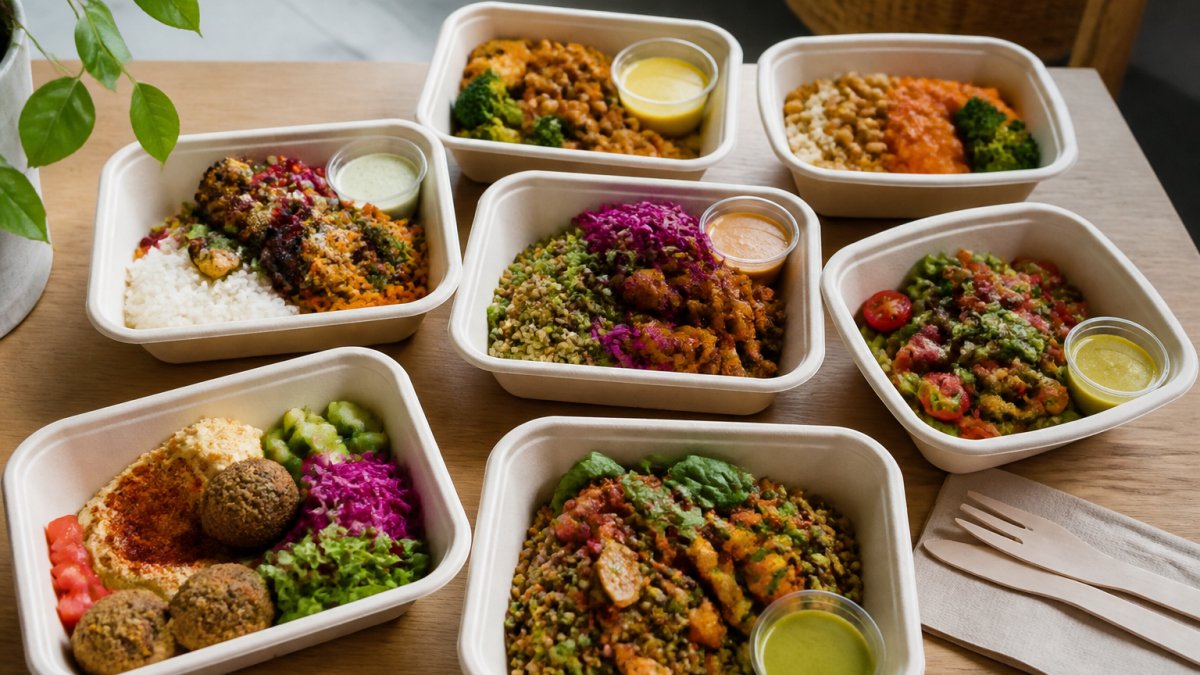
A meal kit hands you ingredients and a recipe, so the dish is yours and the range is limited only by the kit company’s recipe library. But you cook every time, and most people order three to four kits weekly at most. Prepared meals arrive ready to eat, which means you can mix formats across a week without any cooking time.
| Dimension | Prepared meals | Meal kits |
|---|---|---|
| Dishes per week realistically ordered | 5-10 | 3-4 |
| Cooking time per meal | 0-5 minutes | 20-40 minutes |
| Variety source | Menu rotation across weeks | Recipe library within a week |
| Format flexibility (bowl, wrap, soup, hot plate) | High, mix within a week | Low, one recipe per kit |
| Portion control | Fixed per meal | Adjustable by ingredient quantity |
| Leftover potential | Low | Medium to high |
| Best fit | Busy weekdays, lunch at work | Households that enjoy cooking and batch planning |
The household-level calculation competitors skip
Most comparisons stop at the individual eater. The real variety problem appears when one household has mixed preferences: one person wants a hot bowl, another wants a salad, a third needs a smaller portion. With prepared meals, each person can pick a different dish from the weekly menu, which can help households of two or more. Meal kits handle it less well, because one kit produces one dish for everyone.
A practical pattern for mixed households:
- Order prepared meals for the meals where schedules diverge (weekday lunches, late dinners).
- Use one or two meal kits for the meals you eat together and want to cook.
- Plan portions by person, not by dish. If a prepared meal is too large, split it; if a kit is too small, add a legume side.
Avoiding menu fatigue when ordering for more than one person
Menu fatigue in a household rarely comes from one person getting bored. It comes from the household defaulting to the lowest common denominator, the two dishes everyone will accept, and ordering those on repeat.
For anyone ordering lunch on a working day, prepared meals can suit a tight schedule. Variety in a prepared meal plan comes from the rotation, which is why the scorecard above matters more than the recipe count.
Building a Nutritionally Varied Plan for Your Household
Household variety is a planning problem, not a menu problem.
For families, a written checklist keeps the week balanced without guesswork. Our healthy menu checklist shows how to build balanced family meals that stay enjoyable and nutritious.
Belgian nutrition guidance, published by the Belgian Superior Health Council, continues to emphasise plant-based eating within a balanced pattern, which makes rotation across protein sources the practical priority.
Plan Your First Week of Vegan Deliveries
Your first week should test variety, not just taste. Order across at least three formats, note which dishes you’d happily repeat, and keep the scorecard running from day one.
A practical first week looks like this:
- Order two lunches and two dinners across different cuisines
- Pick one dish built on legumes and one on tofu or tempeh
- Note delivery timing against when you actually need to eat
If you’re still weighing up which services fit a working schedule, our overview of healthy meal delivery options for every schedule covers the practical side of ordering. Food safety rules for delivered meals in Belgium are set out by the Federal Agency for the Safety of the Food Chain, which is worth knowing if you’re ordering for a household with allergies.
Frequently Asked Questions
How do I find variety in a vegan meal delivery plan?
Count how many distinct dishes appear across four consecutive weekly menus, not how many are listed on any single day. Look for rotation in the base ingredients too: if every bowl is built on rice and chickpeas, the menu is narrower than it looks. Check whether the provider publishes upcoming menus in advance, and whether you can swap individual dishes before the cut-off. A plan that lets you change two or three items a week gives you far more real variety than one with a fixed weekly line-up.
How often do vegan meal delivery menus usually change?
Most services rotate weekly, with a few seasonal dishes cycling in every month or quarter. Ask two questions before subscribing: how many dishes are new each week, and how many return from the previous week. A weekly refresh of a handful of dishes is normal. What matters is whether the returning dishes are ones you would happily eat again. If a provider cannot show you next week’s menu before you commit, treat that as a warning sign about how much rotation you can expect.
Are vegan meal delivery plans suitable for different dietary needs?
They can be, but only if the provider labels allergens clearly and lets you filter by restriction. Vegan covers what is left out, not what is included, so a gluten-free or nut-free vegan eater needs a second layer of information. Look for per-dish allergen notes, a filter for the restrictions you actually have, and a way to reach a human when two restrictions overlap. If you have a serious allergy, confirm how the kitchen handles cross-contact before your first order rather than after.
Are vegan meal delivery plans available as prepared meals and meal kits?
Both formats exist. Prepared meals arrive ready to eat or reheat, which suits busy lunch and dinner schedules. Meal kits send ingredients and recipes, which gives you more control over cooking but adds prep time and, often, more packaging. For variety specifically, prepared meals depend entirely on the provider’s rotation, while kits depend on how willing you are to cook something new. Many households mix the two: prepared meals on working days, kits at the weekend.
Judging variety takes four weeks and a scorecard, not a marketing page. Wild Foodz prepares plant-based meals fresh daily, with an extensive vegan range, generous portions and a menu that shifts with the seasons, so week three doesn’t taste like week one. Get started with Wild Foodz and build a delivery plan you’ll still be excited about a month in.

Leave a Reply