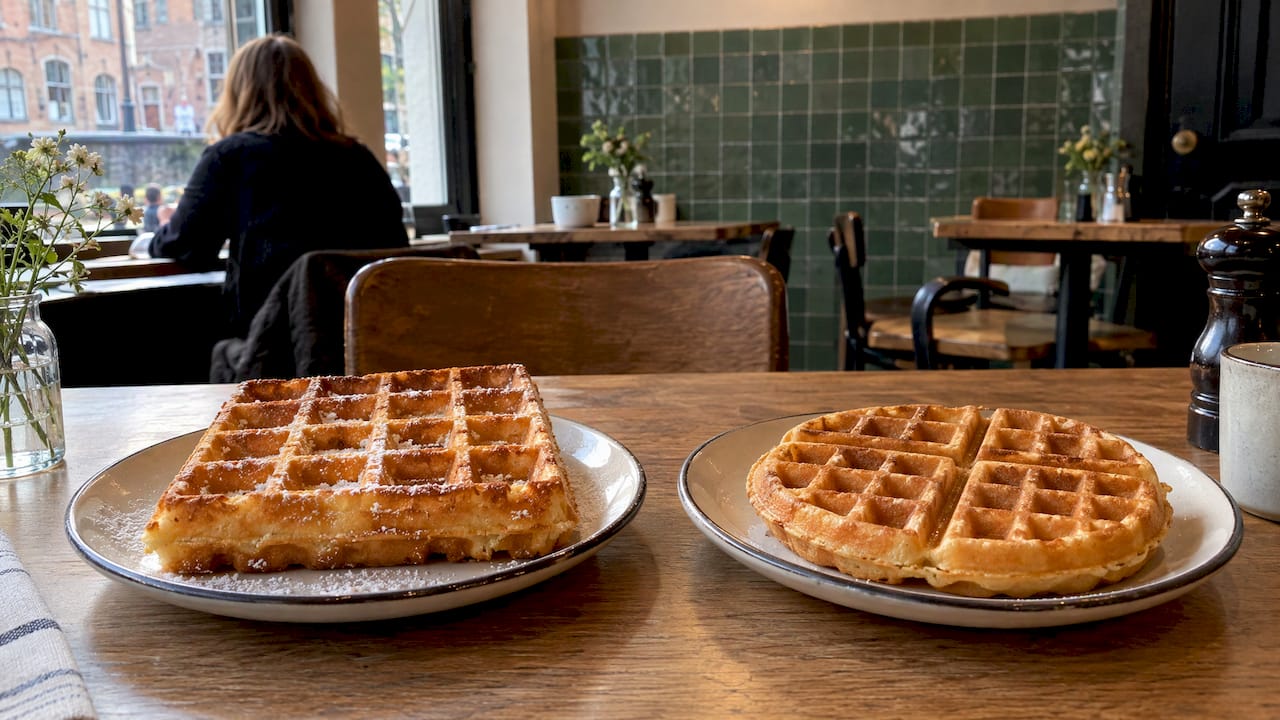


A Belgian waffle is thicker, lighter and has deeper pockets than an American waffle, and the traditional Belgian versions are made with yeast or a rested batter. The American waffle is thinner and denser. It usually runs on baking powder and a shallow iron. The twist is that the “Belgian waffle” on a US brunch menu is itself an approximation of the Brussels waffle, and the waffles you meet on a street in Belgium are often something else again: the Liège waffle. Here in Bruges we serve a seasonal Red Velvet Heart Waffle for Valentine’s Day, so we think about this question a lot.
TL;DR
- Pockets and thickness: Belgian-style irons have deeper grooves, so the waffle is thicker. American irons have shallower indentations and give a thinner waffle (Tasting Table).
- Leavening: Brussels batter is commonly yeast-leavened and may rest for an hour or overnight. American batter generally relies on baking powder and cooks without a long rest.
- Not one Belgian waffle: Brussels (light, rectangular) and Liège (dense, chewy, caramelized sugar) are the two main modern styles in Belgium.
- Toppings: Butter and maple syrup say American. Powdered sugar, fruit and cream say Brussels. Liège is often eaten plain, by hand.
- Pancake? Not the same thing: a waffle is cooked in a patterned iron and a pancake on a flat griddle.
Table of Contents
- Side by side: the quick comparison
- The iron: where the pockets come from
- Batter and leavening: the real technical gap
- Brussels vs Liège: which one is “the” Belgian waffle?
- Where the Belgian waffle comes from
- Toppings: butter and maple vs sugar and fruit
- Belgian waffle vs pancake
- Which one should you choose?
- Waffles in Bruges: our Red Velvet Heart Waffle
- How to tell what you are being served
- Perspective
- FAQ
- Sources
Side by side: the quick comparison
| Feature | American waffle | Brussels waffle (the “Belgian waffle” abroad) | Liège waffle |
|---|---|---|---|
| Shape | Round, square or rectangular | Large rectangle | Oval or irregular |
| Thickness | Thinner, denser | Thick, airy | Thick, dense, chewy |
| Pockets | Shallow, small | Deep, large | Moderate, with caramelized sugar |
| Mixture | Pourable batter | Pourable batter | Rich dough, similar to brioche |
| Leavening | Baking powder or soda | Often yeast, sometimes beaten egg whites | Yeast |
| Typical serving | Butter and maple syrup | Powdered sugar, fruit, cream | Plain, warm, by hand |
The shapes and textures in this table come from the Belgian Waffle Connoisseur, Wikipedia’s Waffle entry and The Brussels Times. Home cooks and cafés vary, so read it as the typical case, not a rule.
The iron: where the pockets come from
The first difference you can see is the iron. Tasting Table reports that Belgian-style irons commonly have deeper grooves, while American irons have shallower indentations and so produce thinner waffles.
Pockets matter because they decide how a waffle eats. A deep pocket holds butter, jam, cream or syrup. A shallow grid gives more crisp surface and less hollow space. The same batter in two irons will not give the same waffle: one comes out tall and soft inside, the other flat and crisp.

The shape differs too. A classic American waffle is round, square or rectangular. A Brussels waffle is a large rectangle with deep indentations (Musea Brugge). A Liège waffle is oval or irregular.
Batter and leavening: the real technical gap
This is where the two styles part ways most.
American waffles. The classic recipe is a pourable, cake-style batter raised with baking powder or baking soda. Belgian Boys describe the contrast between thin American waffles from cake-style batter and the thick, deep-pocketed Belgian-style ones. Because chemical leavening works fast, you can mix and cook straight away. The result is typically a crisp outside and a tender center.
Brussels waffles. The traditional batter is commonly yeast-leavened and may rest for an hour or overnight, according to Tasting Table. CooksInfo associates the Brussels style with batter and beaten egg whites. That slow fermentation and the air folded into the mixture explain the light, airy interior.
Liège waffles. These are a different animal. They use a rich, yeast-leavened dough similar to brioche, with pearl sugar worked in. The sugar melts and caramelizes against the hot iron, which gives the Liège waffle its sweet, crunchy-chewy exterior (CooksInfo).
So the practical difference is time. American batter is built for speed. Traditional Belgian methods trade speed for flavor and structure. The “Belgian waffle” sold in North America is generally an American approximation: pourable batter, commonly baking powder instead of yeast, baked in a deep iron (Belgian Waffle Connoisseur, 2026). That is why a US “Belgian” waffle can look right and still eat differently from one in Brussels.

Brussels vs Liège: which one is “the” Belgian waffle?
Neither, and both. Belgium has more than a dozen regional waffle varieties, including Brussels, Liège, Flemish and Kempense, and Liège is the most common type available in Belgium (Wikipedia). The Brussels Times names Brussels and Liège as the two predominant modern styles.
In short:
- Brussels: an indented rectangle, soft and light, crisp when hot, usually served with some kind of topping.
- Liège: crunchier, more oval, with clumps of sugar in the dough, often eaten warm and plain from a paper bag.
If you are comparing against an American waffle, the Brussels waffle is the closer cousin: both start from a pourable mixture. Musea Brugge notes that in the United States, the term “Belgian waffle” usually refers to this Brussels style.
Where the Belgian waffle comes from
Waffles in the Low Countries are old. Musea Brugge documents waffle irons from the 15th century and says medieval paintings and manuscripts link waffles with festivals, Carnival, Shrove Tuesday and fairs. Sixteenth-century cookbooks already include thick, airy waffles that resemble the modern Brussels waffle.
The American story is more recent. According to the Belgian Waffle Connoisseur, Brussels-style waffles were showcased at Expo 58 in Brussels, introduced in the United States at Seattle’s 1962 Century 21 Exposition and popularized at the 1964 to 1965 New York World’s Fair. CooksInfo credits Maurice Vermersch with popularizing them in New York in 1964, served with strawberries, whipped cream and powdered sugar.
The name itself is a story. The Brussels Times says “Belgian Waffles” was a mistaken reading of “Bel-Gem Brussels Waffles”. Whatever the exact path, the American brunch classic is a descendant of a Brussels waffle that crossed the Atlantic and changed on the way.
Toppings: butter and maple vs sugar and fruit
What goes on top is almost as telling as what is in the batter.
- American: Wikipedia lists butter, maple syrup, fruit syrups, honey or powdered sugar, and savory pairings such as chicken and waffles. Tasting Table also points to maple syrup as the American signature.
- Brussels: butter, powdered sugar and fruit are common. The Brussels Times says butter or cream is accepted, with icing sugar and strawberries too, and it quotes Belgian baker Regula Ysewijn cautioning against piling too much on in the street.
- Liège: commonly eaten plain, by hand, because the caramelized sugar is already the flavor.
- Tourist plates: Belgian street waffles are commonly served warm with confectioners’ sugar, while tourist versions may add whipped cream, soft fruit or chocolate spread (Wikipedia).
A useful rule: the lighter and airier the waffle, the more it can carry. A dense, sugared Liège needs nothing. A big Brussels rectangle takes cream and fruit happily.
Belgian waffle vs pancake
People searching this comparison often wonder where a pancake fits. Pancakes and waffles share basic ingredients. Waffle batter generally contains more fat and sometimes more sugar, and a waffle is cooked in a patterned iron while a pancake is cooked on a flat griddle or skillet, according to Betty Crocker Kitchens. The result is typically a crisp, browned waffle exterior against a softer pancake surface.
A Belgian waffle widens the gap. With yeast, resting time and a deep iron, it ends up lighter and more structured than a pancake. An American waffle sits closer to a pancake, since both can come from a similar cake-style batter.
Which one should you choose?
Choose by mood, not by flag.
- You want a breakfast plate with syrup: an American-style waffle. Thin, crisp, built to soak up maple syrup.
- You want something light that carries fruit and cream: a Brussels-style waffle. Large, airy, deep pockets.
- You want a snack to eat walking: a Liège waffle. Chewy, sweet, no toppings required.
- You want a dessert to share: a shaped, topped seasonal waffle, which is where we come in.
Waffles in Bruges: our Red Velvet Heart Waffle
Bruges has a long waffle tradition, so a visitor asking “where can I eat a waffle here?” has plenty of options. Our seasonal take is the Red Velvet Heart Waffle, a Valentine’s Day special from Wild Foodz by Hotel Entree. You can take it away or have it delivered. The heart shape makes it a dessert to share, and it fits the way a Brussels-style waffle works best: a generous, airy canvas for a dessert rather than a plain street snack.
We serve it alongside our fresh bowls, salads, wraps and specialty drinks, all prepared daily. Delivery is available through Deliveroo, UberEats and Takeaway.com, and we deliver ourselves within a 20-mile radius. If you want the story behind the dish, read about the Red Velvet Heart in Bruges, or see how Valentine’s waffles are shared. For where we deliver, see our delivery zone in Bruges. To order, go to Wild Foodz by Hotel Entree.

The Red Velvet Heart Waffle is a seasonal item tied to Valentine’s Day, so check our site for the current availability. If you are planning a whole Valentine’s dessert table, our Valentine’s dessert ideas go from molten cake to red velvet waffles, and our seasonal specialties in Bruges show what else changes with the calendar.
How to tell what you are being served
Menus use “Belgian waffle” loosely, so a few quick clues help:
- Look at the shape. A large rectangle with deep squares suggests Brussels style. An oval with a lumpy, glossy surface suggests Liège.
- Look at the surface. Visible caramelized sugar points to a Liège dough with pearl sugar.
- Check the toppings. Maple syrup and butter point to the American approach. Powdered sugar and fruit point to Brussels.
- Feel the weight. A thick, airy waffle with a crisp outside and soft inside is the Brussels ideal when hot. A heavy, chewy one is a Liège.
Perspective
We make food that looks as good as it tastes, and a waffle is one of the best canvases for that. When we put a Red Velvet Heart Waffle on the menu for Valentine’s Day, we are not trying to settle the Belgian against American argument. We are asking what makes a waffle worth sharing.
Our answer is color, shape and a moment. A heart-shaped red velvet waffle turns a familiar treat into something you plan an evening around, whether you pick it up on the way home or have it delivered to your hotel or apartment. In a city that has served waffles for centuries, we like adding a seasonal chapter of our own.
The history shows that waffles have always been tied to festivals and fairs. Valentine’s Day is one more reason to celebrate, and we are happy to bring the waffle to your table.
Mawghan
FAQ
What is the main difference between Belgian and American waffles?
The main difference is depth and lightness. Belgian-style waffles are thicker with deeper pockets, while American waffles are thinner and denser with shallower pockets. Traditional Belgian batter is often yeast-leavened, and American batter generally uses baking powder.
Is a Belgian waffle the same as a Brussels waffle?
Nearly, but not exactly. Abroad, “Belgian waffle” usually means the Brussels style, a large rectangle with deep indentations and an airy texture. In Belgium, however, Liège waffles are the most common type, and they are a different style made from a sugared, yeasted dough.
Where did the Belgian waffle originate?
Waffle irons are documented in the Low Countries from the 15th century. The Brussels style was showcased at Expo 58 and popularized in the United States at the 1964 New York World’s Fair.
Is a waffle different from a pancake?
Yes. Waffle batter generally contains more fat and sometimes more sugar, and a waffle is cooked in a patterned iron rather than on a flat griddle. That gives a waffle a crisper, browned exterior.
Which toppings suit which waffle?
Maple syrup and butter suit American waffles. Powdered sugar, fruit and cream suit Brussels waffles. Liège waffles are usually eaten plain, since the caramelized pearl sugar already sweetens them.
Sources
- Belgian Vs Regular Waffles: What’s The Difference? (Tasting Table)
- Belgian Waffle vs. Regular Waffle: 5 Differences (Belgian Boys)
- What is the difference between Belgian and American waffles (Belgian Waffle Connoisseur)
- Belgium’s dividing line? Brussels versus Liège waffles (The Brussels Times)
- Burgundian wafer irons (Musea Brugge)
- Belgian Waffles (CooksInfo)
- Waffle (Wikipedia)
- Pancakes vs. Waffles (Betty Crocker)
Leave a Reply