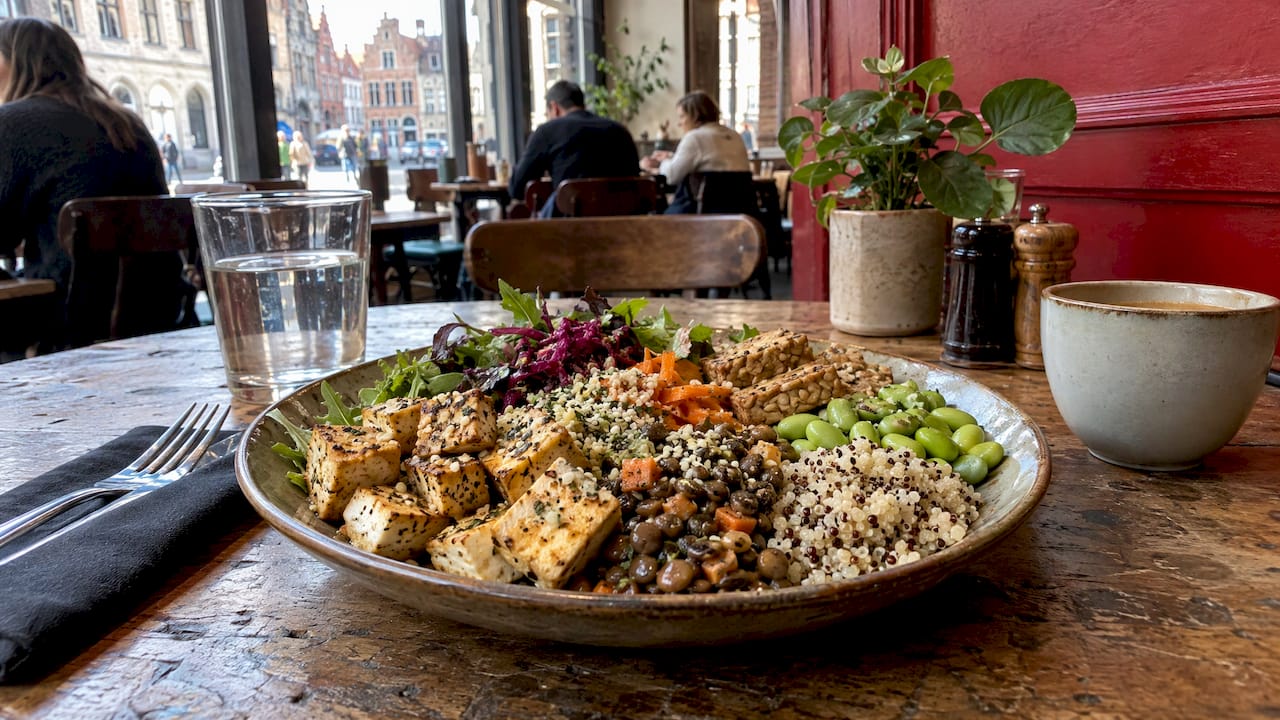


The best vegan protein sources are tempeh, tofu, soy products, lentils, beans, chickpeas, seitan, and seeds such as hemp and pumpkin. You don’t need to combine them at every meal. Spread across a day, they cover your needs. In Brugge, we build our bowls, salads and wraps around these foods, and in season we finish the meal with our Red Velvet Heart Waffles, because a vegan day is allowed to end on something sweet.
This guide gives you the numbers per portion, a simple way to combine foods, and an easy way to put it all on a plate whether you are cooking at home or traveling.
TL;DR
- Highest per 100 g: hemp seeds (30 g), peanuts (25.8 g), pumpkin seeds (24.4 g), tempeh (20.7 g), tofu (16.5 g). Per cooked cup, lentils and beans give roughly 15 to 18 g.
- Belgian guidance puts protein needs about 1.3 times higher for vegans than for people on a mixed diet, so portions of legumes, soy and seeds matter at every meal.
- Complementing foods (grains with legumes, oats with nuts) works across the whole day, not meal by meal.
- Bowls, salads and wraps are the easiest format for this, and a waffle treat fits after a protein-rich main.
Table of Contents
- Why vegans need to plan protein a little more
- The best vegan protein sources, per portion
- Complete plant proteins: what they are and which ones count
- Combining foods without the stress
- A day of eating that reaches roughly 75 g
- Eating this way when you aren’t at home
- The Red Velvet Heart Waffle: where it fits
- Order a protein-forward meal in Brugge
- Our perspective
- FAQ
- Sources
Why vegans need to plan protein a little more
Protein from plants is digested slightly less completely than protein from animal foods, and individual plant foods are low in one amino acid or another (the building blocks of protein). Belgium’s official nutrition recommendations therefore state that the protein requirement is 1.2 times higher for vegetarians and 1.3 times higher for vegans than for people eating a mixed diet.
The same Belgian advice sets the adult recommendation at 0.83 g per kg of body weight per day, and at least 1.2 g/kg for endurance athletes. For a 70 kg adult that is about 58 g on a mixed diet. Multiply by 1.3 for a vegan diet and you land near 75 g a day. That is a planning figure, not a medical prescription. If you are pregnant, training hard, older, or managing a health condition, talk to your doctor or a registered dietitian about your own target.
It is not a cause for alarm. In a large UK cohort reviewed in the literature, 16.5% of vegan men and 8.1% of vegan women had intakes below their requirement, against 3% and 1% of meat eaters. The review links low protein partly to low overall energy intake: eating enough food, with a legume, soy product or seeds at each meal, closes most of that gap.
The best vegan protein sources, per portion
Sources report protein in different units (per 100 g, per cup, per ounce), which makes comparison confusing. Here are the main foods in the units you will actually meet.
Per 100 g, the densest foods
BBC Good Food’s ranking gives these values per 100 g: hemp seeds 30 g, peanuts 25.8 g, pumpkin seeds 24.4 g, tempeh 20.7 g, cashews 17.7 g, soya mince 16.6 g, tofu 16.5 g and chia seeds 16.5 g. Hemp seeds are also a complete protein, meaning they contain all nine essential amino acids.

Keep in mind that you eat seeds by the tablespoon, not by the 100 g. They are a booster, not a main.
Per cooked cup or serving, the foods you actually plate
The US Department of Veterans Affairs’ plant protein guide lists tempeh at 34 g per cup, cooked soybeans 31 g, cooked lentils 18 g, and black, kidney or chickpea beans around 15 g per cup. It also gives seitan at 21 g per 3 oz, extra-firm tofu at 12 g per 4 oz, cooked quinoa at 8 g per cup, and plain soy milk at 7 g per cup.
A quick reference:
| Food | Typical protein | Portion |
|---|---|---|
| Tempeh | 34 g | 1 cup |
| Soybeans, cooked | 31 g | 1 cup |
| Seitan | 21 g | 3 oz |
| Lentils, cooked | 18 g | 1 cup |
| Chickpeas and beans, cooked | 15 g | 1 cup |
| Extra-firm tofu | 12 g | 4 oz |
| Quinoa, cooked | 8 g | 1 cup |
| Soy milk, plain | 7 g | 1 cup |
Values vary by brand and preparation, so read the label on packaged tofu, tempeh and seitan.
The Belgian view: portions in grams
If you shop in Belgium, the public-health site NICE uses metric portions. A standard serving of legumes is 100 g cooked (about 40 g dried), giving roughly 9 g of protein and 9 g of fiber. Its food-triangle guidance also counts 100 g of tofu or tempeh as about 12 g of protein each, and 450 to 600 ml of soy drink as 16 to 21 g. Belgian sources also point out that tofu and soy drink are the plant foods with a high biological value, since soy proteins are considered high-quality plant proteins.
Complete plant proteins: what they are and which ones count
A complete protein contains all nine essential amino acids, the ones your body cannot make. Soy is the best-known plant example: Cleveland Clinic’s dietitian describes soy as a complete protein with 8 to 18 g per serving, available as edamame, soy milk, tempeh and tofu. So yes, tofu counts. Tempeh does too, and it is made from fermented whole soybeans, whereas tofu is made from soy milk.

Quinoa is another one, and it’s often misjudged. Cooked quinoa has only about 4 g of protein per 100 g, but it is one of the few plants with a well-balanced amino acid profile, and it is gluten-free. Quinoa is a good base, but it is not a high-protein food on its own. Pair it with beans, tofu or seeds if you want it to carry a meal.
Combining foods without the stress
You may have heard that vegans must pair rice and beans at every sitting. You don’t. Belgium’s child and family agency states that combining protein sources need not happen at every meal, as long as all essential amino acids are provided in adequate amounts over a full day.
The logic is simple. Legumes are low in methionine, while grains like rice, wheat and maize are low in lysine, so grains and legumes complement each other. NICE gives pea soup with bread and rice with lentils as examples, and also recommends oats with nuts. In practice:
- Eat a legume or soy food at every main meal. Lentils, chickpeas, beans, tofu or tempeh.
- Add a grain, nuts or seeds somewhere in the day. Bread, rice, quinoa, oats, or a spoonful of pumpkin seeds.
- Add vegetables rich in vitamin C. Legumes give less absorbable iron than meat, and vitamin C from vegetables boosts iron absorption.
- Vary the sources. It improves taste and nutrition at once.
Vitamin B12 is the one nutrient legumes don’t provide, and it is relevant to every vegan diet. Ask your doctor or dietitian about a supplement.
A day of eating that reaches roughly 75 g
Here is an illustrative day using the figures above. It is an example, not a prescription.
- Breakfast: oats made with 250 ml soy drink (about 7 g from the drink plus a few from the oats) and a tablespoon of seeds.
- Lunch: a bowl with 100 g tofu or tempeh (12 to 20 g), a cooked grain base, greens and seeds.
- Snack: a handful of peanuts or cashews.
- Dinner: lentil or chickpea stew, 150 g cooked (about 14 g on the NICE average of 9 g per 100 g), with bread or rice.
The soy drink, tofu or tempeh, legumes, nuts and bread add up quickly. For reference, NICE’s food-triangle example sums to 62 to 90.5 g of protein per day from plant foods alone.
Eating this way when you aren’t at home
Travel is where vegan protein planning usually falls apart. Hotels and cafes in a tourist town lean on bread, pastry and fries, and a salad of lettuce and tomato gives you little protein. The easiest fix is a format where you can see the protein: a bowl, a hearty salad or a wrap.

We prepare bowls, salads, wraps and specialty drinks fresh every day at our new central Brugge location, with extensive vegan options featuring superfoods and seeds such as acai. You can take your order away, or have it delivered through the main delivery platforms or by us within a 20-mile radius, which suits hotel guests, business travelers and families who would rather eat in their room.
If you want to build the same meals at home, our articles walk through each one:
- A 25 g plant protein bowl, cooked fast or ordered.
- How to build a balanced bowl, with a protein target and a base weight.
- Legumes in salads and which to use.
- Vegan protein wraps, with protein numbers for each filling.
- Tempeh versus seitan, if you can’t decide which to cook.
- Two 25 g meal prep lunches for the working week.
- A protein smoothie without powder in five minutes.
The Red Velvet Heart Waffle: where it fits
Let’s be honest about what a waffle is. It is a treat, not a protein source, and nobody should count it toward 75 g. That is exactly why it works well at the end of a day or a meal that has already done the protein work: a bowl with tempeh or tofu, a lentil salad, or a loaded wrap, followed by something sweet and beautiful.
Our Red Velvet Heart Waffles are our Valentine’s Day special, a seasonal offering that follows the same idea as the rest of our menu: bright color, vivid presentation, made to be photographed and shared. Waffles are what many visitors to Brugge come looking for, and we like that you can have a real meal and a waffle in the same order. Our wrap and family articles show how we think about it: a protein wrap with a red velvet finish or a vegan family dinner with a red velvet waffle treat. Check our site for the current availability of the waffles, as they are a seasonal item.
A practical tip for families: order the main first, with the protein at its center, and treat the waffle as the shared dessert. Children and older adults need particular attention to protein, so a portion of tofu, tempeh or cooked legumes at the main course matters more than the dessert. Kind en Gezin’s portions for toddlers from 12 months, for example, are 40 g of tofu, 25 g of tempeh or 70 g of cooked legumes. For infants and young children on a vegan diet, follow the advice of your pediatrician or a dietitian.
Order a protein-forward meal in Brugge
If you are in Brugge, or staying in a hotel nearby, and want a fresh vegan bowl, salad or wrap with a real protein component, plus the Red Velvet Heart Waffle in season, order directly from us for takeaway or delivery. Everything is prepared daily.
Order from Wildfoodz by Hotel Entree

Our perspective
Most people who ask us about vegan protein are really asking a different question: what do I eat tonight that is easy, tastes good and keeps me full? The numbers matter, and we have given them above. But a gram table does not make dinner.
What works, in our experience of how we design the menu, is a plate you can read at a glance: a base, a legume or soy protein, vegetables, and seeds on top. That is why we build around bowls, salads and wraps, with extensive vegan options and superfoods and seeds such as acai. Seeds are small, but they are an easy way to add protein and crunch to almost anything.
And then there is joy. A meal should not feel like a nutrition exercise. We like color, we like presentation, and we like a finish that makes people smile, which is why the Red Velvet Heart Waffle sits on our seasonal menu next to the bowls. Eat well in the middle of the day, and enjoy the waffle at the end.
Mawghan
FAQ
Which vegan food is richest in protein?
Per 100 g, hemp seeds lead at about 30 g, followed by peanuts, pumpkin seeds and tempeh at around 20.7 g, according to BBC Good Food’s ranking. For a full meal portion, tempeh, soybeans and lentils give the most protein per cup.
Is tofu a complete protein?
Yes. Tofu is made from soy, and soy contains all nine essential amino acids. Belgian guidance also describes tofu and soy drink as plant foods with high biological value. A 100 g portion gives about 12 to 13 g of protein.
Is quinoa a good source of protein?
It is a complete, gluten-free protein, but a modest one by quantity: about 4 g per 100 g cooked, per Eco-conso. It works best as a base combined with beans, tofu or seeds.
How do I get enough protein on a vegan diet?
Eat a legume or soy food at every main meal, add grains, nuts and seeds across the day, and eat enough overall. Belgian guidance suggests vegans need about 1.3 times the protein of a mixed diet, so aim for roughly 1 g per kg of body weight or a bit more, and ask a dietitian for a personal target.
Sources
- The 15 best vegan protein sources, BBC Good Food
- Plant-Based Protein Guide, US Department of Veterans Affairs
- Voedingsaanbevelingen voor België, health.belgium.be
- Recommandations nutritionnelles pour la Belgique, health.belgium.be
- Dietary Protein and Amino Acids in Vegetarian Diets, review
- Peulvruchten: groente en/of eiwitbron, Voedingsinfo NICE
- Eiwitten en gezondheid, Voedingsinfo NICE
- Eiwitten in de voeding, Voedingsinfo NICE
- Vegetarische voeding, Kind en Gezin
- A Guide To Plant-Based Protein Sources, Cleveland Clinic
- Tempeh: Health Benefits & Nutrition, WebMD
- Par quelles protéines végétales remplacer la viande ?, Eco-conso
Leave a Reply