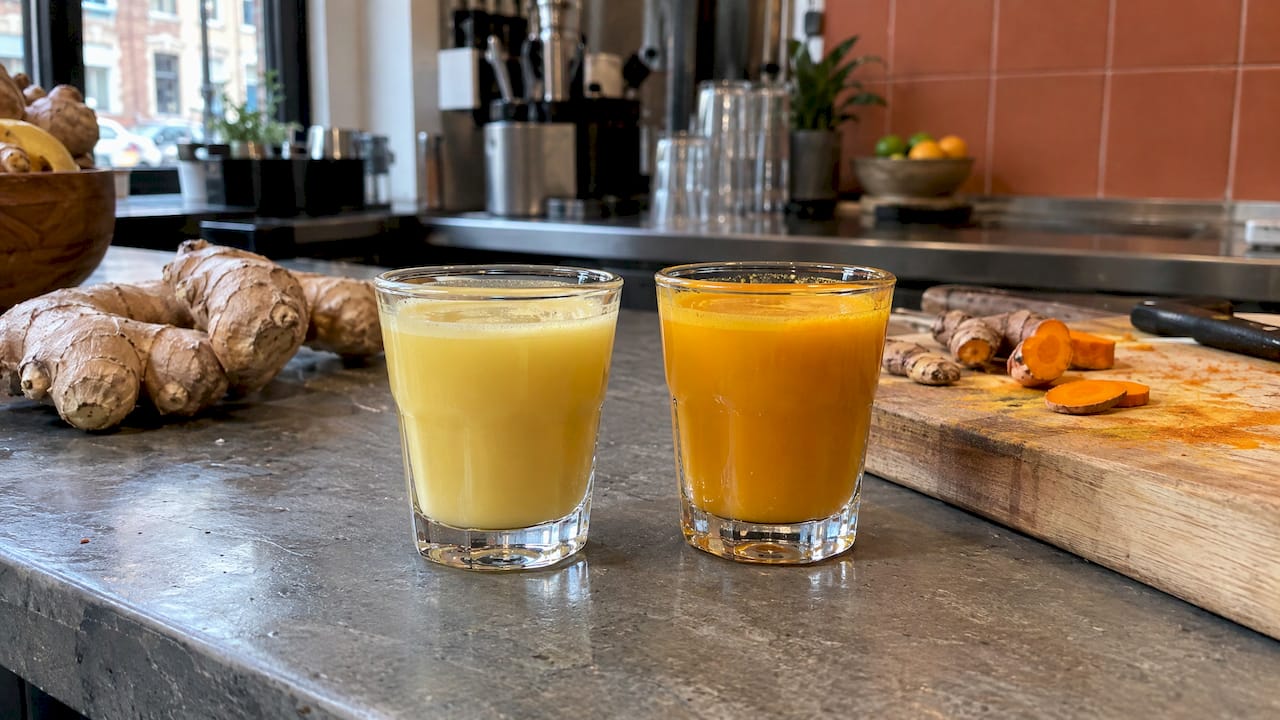


Pick a ginger shot if you want a quick, fiery drink that sits well with a light stomach and a meal. Pick a turmeric shot if you like an earthy, golden drink and are happy to make it properly, with black pepper and a little fat. Neither is a medicine, and neither needs to be a daily ritual. Here is how they differ in taste, evidence and safe use, and how to make the rest of your day taste as good as the shot does. At Wild Foodz by Hotel Entree in Brugge, that means fresh bowls, wraps, specialty drinks and our seasonal Red Velvet Heart Waffles.
TL;DR
- Ginger shots are sharp, hot and citrusy. Turmeric shots are earthy, slightly bitter and golden. Most people find ginger easier to drink straight.
- Ginger has the better-documented human benefits (pregnancy nausea, some osteoarthritis pain). Evidence that either shot boosts immunity is thin.
- Turmeric needs black pepper to be absorbed well, and concentrated curcumin products have been linked to liver problems. Ginger’s main downsides are heartburn and diarrhea in large amounts.
- Shop-bought shots can hold two to three sugar cubes’ worth of sugar, so read the label.
- Pair a small shot with real food. A bowl for lunch and a Red Velvet Heart Waffle as a treat is a better plan than chasing a miracle drink.
Table of Contents
- Ginger shot vs turmeric shot at a glance
- What is actually in each shot
- Taste and how to drink them
- What the evidence says
- How much is reasonable
- Who should be careful
- Watch the sugar, not just the root
- A sweeter way to finish the meal
- Order fresh, eat well
- Our view on wellness shots
- FAQ
- Sources
Ginger shot vs turmeric shot at a glance
| Ginger shot | Turmeric shot | |
|---|---|---|
| Main ingredient | Fresh ginger juice, often cut with orange or lemon | Fresh or ground turmeric root, usually blended with ginger |
| Taste | Hot, sharp, peppery, bright | Earthy, mildly bitter, golden |
| Color | Pale yellow to light amber | Deep yellow to orange (it stains) |
| Needs black pepper? | No | Yes, to help absorb curcumin |
| Best-documented use | Pregnancy-related nausea, some osteoarthritis pain | Preliminary lab findings only for inflammation |
| Typical side effects | Heartburn, abdominal discomfort, diarrhea | Nausea, reflux, stomach upset, rare liver concerns with concentrated products |
| Easiest to drink | Straight, small amount | Blended with ginger, pepper and citrus |
What is actually in each shot
Belgian fact-checkers at VRT NWS define a ginger shot as a small glass of about 30 ml (roughly one ounce) of concentrated ginger juice, often diluted with orange or lemon juice. The same piece notes that some commercial shots contain up to 30 g of ginger each.
A turmeric shot is usually a blend. A typical home recipe, as described by Health.com, chops fresh ginger and turmeric into pieces of one to two inches, blends them with black pepper, optional orange and water, strains the result and keeps it in the fridge for up to five days. That explains why “ginger vs turmeric shots” is often a false choice: many bottles and recipes contain both.

The black pepper matters. The U.S. National Center for Complementary and Integrative Health (NCCIH) explains that curcumin, turmeric’s active compound, is poorly absorbed on its own and that piperine from black pepper is one way to improve absorption. Our own article on why pepper and fat change what a turmeric shot does goes deeper on that.
One small curiosity: curcumin is also the reason turmeric stains. It is authorized in the EU as a food coloring additive, E 100. So the golden color of a shot says nothing about how much curcumin your body will absorb.
Taste and how to drink them
Ginger hits the back of the throat first. A pure shot is intense, which is why most recipes add orange or lemon. If you are new to it, dilute it. Cleveland Clinic suggests diluting ginger juice and, if your digestion is sensitive, starting with 0.5 to 1 ounce. Our guide to a 15 to 20 ml half shot of ginger uses the same gentle-start logic.
Turmeric is mellower in heat but heavier in flavor: earthy, a little bitter, slightly medicinal. Black pepper adds bite, a squeeze of lemon lifts it, and a few drops of oil or a bite of something with fat in it helps absorption.
If you cannot decide, the blended version is the sensible compromise. Ginger carries the flavor, turmeric adds color and earthiness, and pepper does the technical work.
What the evidence says
This is where the marketing runs ahead of the science, so keep your expectations modest and specific.
Ginger
NCCIH’s ginger summary says ginger may help with nausea and vomiting in pregnancy, that most motion-sickness studies found no benefit, and that supplements might reduce menstrual cramp severity and knee osteoarthritis symptoms, though much of that research is of poor quality. Tess De Bruyne of the University of Antwerp, quoted by VRT NWS, singles out pain reduction in osteoarthritis as ginger’s best-documented human benefit.
Turmeric
For turmeric, NCCIH describes preliminary laboratory findings that curcumin may have anti-inflammatory properties, but not enough evidence to support turmeric for inflammatory disorders. The European Food Safety Authority has not approved a health claim for curcumin in osteoarthritis, which reflects insufficient evidence at the time of assessment rather than proof of no effect.
The immunity question
The most common reason people buy a shot is to “boost immunity”. Belgian researchers consulted by VRT NWS found no human studies showing that a ginger shot does this: the antibacterial and antiviral effects seen in cell and mouse studies were for ginger oil and fresh ginger, not ginger juice. Treat a shot as a flavorful habit, not a shield against winter colds.
So which one wins?
On evidence, ginger has the clearer track record for nausea and osteoarthritis pain. On everyday pleasure, it is a matter of taste. If your goal is simply a bright, warming drink with a meal, ginger is the easier daily choice. If you enjoy turmeric’s earthiness, make it with pepper and have it with food.

How much is reasonable
There is no official “shot dose”, so use the figures that exist for ginger and keep turmeric occasional.
- Ginger: KU Leuven researcher Inge Lodewijckx, quoted by VRT NWS, says clinical studies recommend no more than 3 g of ginger per day for up to three months. One gram equals about a teaspoon of grated fresh ginger. Above that, acid reflux, heartburn and diarrhea become more likely.
- Starting amount: half a shot, diluted, with food.
- Turmeric: NCCIH says conventionally formulated oral turmeric is likely safe in recommended amounts for up to two or three months. A homemade shot with turmeric root is closer to food use than a capsule, but the sensible habit is a small glass, not a daily litre.
Morning or evening? No trial has compared times of day, so choose the time your stomach likes. If a shot upsets you, have it with a meal and skip it late in the evening if you get heartburn.
Who should be careful
This is the part to read before you buy or blend anything.
- Blood thinners. Healthline notes that large amounts of ginger might have blood-thinning effects and that people taking warfarin may want to avoid ginger shots. Ask your doctor or pharmacist first. A Belgian pharmacist can check this in minutes.
- Liver and gallbladder. NCCIH links highly bioavailable curcumin formulations to liver damage. Watch for fatigue, nausea, poor appetite, dark urine and jaundice, and see a doctor if they appear. If you have gallstones or bile-duct or liver disease, speak to your doctor before drinking turmeric shots.
- Pregnancy and breastfeeding. NCCIH says turmeric supplements during pregnancy may be unsafe and that little is known about amounts above normal food use while breastfeeding. Ginger is studied for pregnancy nausea, but talk to your midwife or doctor about the amount.
- Children and teenagers. Belgium’s federal health service says plant-based supplements with concentrated plant extracts are generally better not given to people under 18. That is a practical rule for family trips: shots are an adult drink.
- Sensitive stomach. Both can cause reflux, stomach upset or diarrhea. Dilute, go small and drink with food.
Watch the sugar, not just the root
The biggest difference between two bottles is often not ginger versus turmeric but what else is in them. VRT NWS reports that many commercial shots hold two to three sugar cubes’ worth of sugar. Healthline adds that added sugar or fruit juice can push calorie intake up. A shot made with root, lemon and water is a very different product from one sweetened with apple juice concentrate.
This is also why a shot works best as a small accompaniment. It does not replace protein, fiber or vegetables. If you want to build a lunch around one, a balanced bowl with 25 g of protein does the heavy lifting, and the shot is the bright note beside it.
A sweeter way to finish the meal
Here is a pairing we like on a cold Brugge day. Start with something fresh and savory, such as a bowl, salad or wrap, with a small ginger-forward drink if you enjoy one. Then end with something indulgent, because a meal that feels like a treat is easier to keep up than a joyless wellness routine.
That is where our Red Velvet Heart Waffles come in. They are our seasonal waffle, promoted around Valentine’s Day, with the deep red color and soft cocoa character red velvet is known for. If you are in Brugge and looking for waffles that are not the usual tourist-street kind, this is the one we would point you to. Ask or check our site for when they are available, since they are a seasonal offering.
We also use the waffle as a finishing touch in other dishes: see our ideas for a Red Velvet waffle twist on bowl bases and a Red Velvet finish on vegan wraps.
Order fresh, eat well
Wild Foodz by Hotel Entree prepares healthy, colorful meals daily: bowls, salads, wraps and specialty drinks, with a broad range of vegan options featuring superfoods and seeds like açaí. You can take your order away from our central Brugge location or have it delivered through Deliveroo, Uber Eats or Takeaway.com, and we also deliver ourselves within a 20-mile radius.

Whether you are a visitor staying at a hotel in Brugge, a local who wants quality food at home or a traveler between meetings, start at our ordering page and add the Red Velvet Heart Waffle when it is on the menu.
Our view on wellness shots
We love the idea behind a ginger or turmeric shot: something vivid, fresh and a little bold in a small glass. That is how we think about food generally. Color, freshness and flavor are what make people eat well for longer than a week.
What we would tell a friend is simple. Enjoy the shot for what it is, a warming, zingy sip, and build the meal around real ingredients: a base, plenty of vegetables, a protein, seeds and a sauce you actually like. Our bowls, salads and wraps are prepared daily with exactly that in mind, and our vegan range leans on superfoods and seeds such as açaí.
And then, once in a while, have the waffle. Our Red Velvet Heart Waffle is the kind of dish that people photograph before they taste it, and it is a good reason to sit down, slow down and enjoy lunch in Brugge.
Mawghan
FAQ
What is better, ginger or turmeric?
For everyday drinking, ginger is easier on the palate and has the clearer human evidence, mainly for pregnancy nausea and osteoarthritis pain. Turmeric is better thought of as an earthy ingredient to blend with ginger and black pepper. Neither is proven to prevent illness.
Is it better to have a shot in the morning or at night?
No trial has compared times of day, so there is no best time. Take it when your stomach tolerates it, ideally with food. If you get heartburn, avoid late evening.
How much ginger shot can I drink in a day?
Studies cited by Belgian researchers recommend keeping ginger to about 3 g a day, roughly three teaspoons of grated fresh ginger, for no more than three months. Start with half a shot, diluted, especially if your digestion is sensitive. Check with your doctor first if you take blood thinners.
Can I drink a ginger shot while pregnant?
Ginger is studied for pregnancy-related nausea, but turmeric supplements may be unsafe in pregnancy, so blended shots deserve a conversation first. Ask your midwife or doctor before adding either to your routine.
Sources
- CHECK: Versterken gemberdrankjes je immuunsysteem? (VRT NWS)
- 7 Reasons To Take a Ginger and Turmeric Shot Every Day (Health.com)
- Turmeric: Usefulness and Safety (NCCIH)
- Ginger: Usefulness and Safety (NCCIH)
- Nutritional Approaches for Musculoskeletal Pain and Inflammation (NCCIH)
- Food Supplements in Osteoarthritis: A Practical Framework (PMC)
- Safety and efficacy of turmeric extract, turmeric oil (EFSA, PMC)
- 6 Ginger Shot Benefits (Cleveland Clinic)
- Are Ginger Shots Healthy? (Healthline)
- Bijkomende informatie over voedingssupplementen die planten bevatten (FOD Volksgezondheid)
Leave a Reply