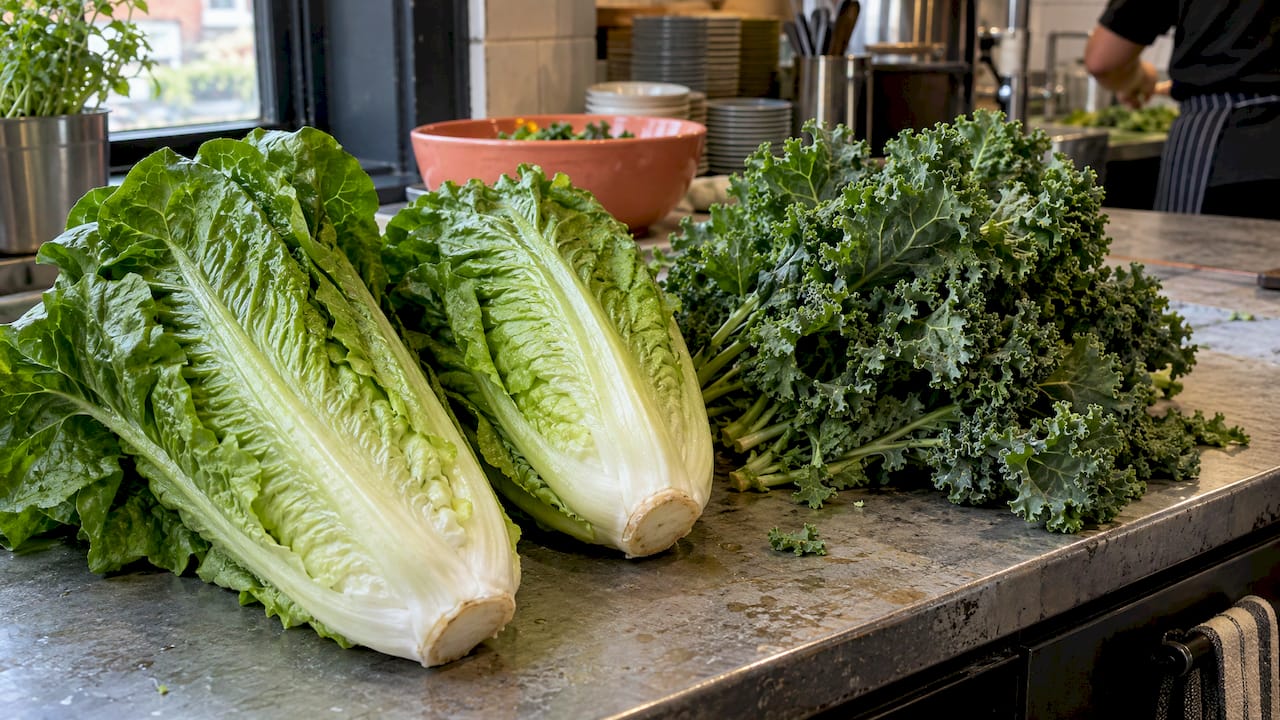


Romaine is the crisp, juicy, mild green you want when a salad or wrap should be fresh and light. Kale is the denser, more bitter green that packs more fiber, vitamin C, vitamin K and calcium per 100 g. Neither wins outright: the better pick depends on what you are building and how soon you will eat it. Here is how they differ on taste, nutrition and everyday use, and how to combine them so you get the best of both.
TL;DR
- Romaine has about 17 kcal per 100 g, kale about 35 kcal, so kale is denser in calories and in nutrients.
- Kale leads on fiber, vitamin C, vitamin K and calcium. Romaine leads on vitamin A and folate.
- Romaine is crisp and sweet-peppery. Kale is earthy, slightly bitter and chewy, and it holds up better once dressed.
- Mixing the two gives a balanced salad: crunch from romaine, depth and staying power from kale.
- Whatever you choose, aim for at least 300 g of vegetables a day, the figure in Belgium’s 2025 dietary recommendations.
Table of Contents
- Taste and texture: crisp versus chewy
- Nutrition per 100 g
- When to choose romaine, when to choose kale
- Why the best salad uses both
- Getting your 300 g a day
- Where we come in
- Our view
- FAQ
- Sources
Taste and texture: crisp versus chewy
Romaine grows in long, light-green heads with a pronounced central rib. Serious Eats describes it as crunchy and firm, with a cool, mild flavor, and notes that the sturdy hearts survive a quick grill. LettuceInfo.org calls it crisp with a mild, sweet taste.
Kale is the opposite in personality. Its leaves are dark, curly or flat, firm and fibrous, and the flavor runs from nutty and earthy to bitter. Raw, it has a slightly peppery bite. According to Hitchcock Farms, kale works well in salads, soups and smoothies, while romaine suits salads, wraps and lettuce cups. They also note that kale can stand in for romaine in a salad, though romaine stays crispier and juicier.
The practical difference shows up once the dressing goes on. Chef Andrew Kaplan told Tasting Table that romaine wilts within about ten minutes of dressing, while kale holds up and even improves after sitting five to ten minutes in acid. If you are packing a lunch to eat later, that matters.
Taking the edge off kale
If raw kale feels tough or bitter, three fixes work. Cut it into thin ribbons, massage it with a little oil, or add something sweet or acidic such as fruit or lemon juice. The Foundation G+E kale page lists these same approaches, along with a brief blanch.
Nutrition per 100 g
The figures below are raw values per 100 g, from USDA data as compiled by Veggie Versus. Databases differ slightly in their numbers, so treat them as a good guide rather than an exact label.
| Per 100 g, raw | Romaine | Kale |
|---|---|---|
| Calories | 17 kcal | 35 kcal |
| Protein | 1.23 g | 2.92 g |
| Fiber | 2.1 g | 4.1 g |
| Vitamin C | 4 mg | 93.4 mg |
| Vitamin A (RAE) | 436 µg | 241 µg |
| Vitamin K | 102 µg | 390 µg |
| Folate | 136 µg | 62 µg |
| Calcium | 33 mg | 254 mg |
| Potassium | 247 mg | 348 mg |
| Iron | 0.97 mg | 1.6 mg |
What the numbers mean
Kale roughly doubles the fiber and protein of romaine and carries far more vitamin C, vitamin K and calcium. Romaine is the better source of vitamin A and folate, and it is the lighter option if calories per bite matter to you.

Romaine is about 95% water. A University of Florida extension publication explains that this water dilutes its nutrients compared with kale at about 85%, so you need a larger portion of lettuce to get the same benefit. The same authors point out that lettuce is not nutrient-poor, and that eating big raw portions preserves heat-sensitive vitamins.
Is kale a superfood?
Dietitian Michael Joseph at Nutrition Advance notes that kale is among the most nutrient-rich leafy greens, but that your overall diet matters more than any single food. Variety is the sensible approach: use both greens, and others too.
Safe use: vitamin K and medication
Both greens contain vitamin K. If you take a blood thinner such as warfarin, keep your intake of vitamin K-rich greens steady from week to week rather than cutting them out, as Medical News Today explains. Your doctor or pharmacist can tell you what is right for your treatment.
When to choose romaine, when to choose kale
Wraps and lettuce cups. Romaine leaves are crisp and juicy and fold easily around fillings. Kale’s chew makes a sturdier wrap, according to Kaplan. Both work. For filling ideas, see our vegan wrap fillings.
Caesar-style salads. Romaine is the classic. Kale, thinly sliced, makes the dressing and Parmesan taste bolder and keeps its structure.
Cooked dishes. Kale is far more versatile hot: soups, stews, risotto toppings, curries, even baked chips. Romaine hearts can also be grilled or lightly sautéed, but they are a quick-cook green.
Smoothies and juices. Kale blends well with apple and ginger. Romaine is milder if you want a green smoothie without the earthy edge.
Lunch you will eat later. Choose kale, or dress romaine only just before eating. Hitchcock Farms gives romaine a longer fridge life, two to three weeks versus five to seven days for kale, so romaine is the one to buy if you will not use it for a while.
Why the best salad uses both
LettuceInfo.org suggests blending neutral greens like romaine with robust ones like kale to balance a salad’s overall flavor, since flavor combines aroma, taste and texture. In practice that means a base of shredded romaine for freshness and volume, a handful of finely cut kale for depth and nutrients, and a dressing with some fat.

That last point is not only about taste. Vitamin K and carotenoids are fat-soluble, so, as the team at Dr. Axe notes, olive oil or avocado helps your body absorb them. Add seeds, a plant protein and a little fruit and you have a complete bowl. Our guide to building a balanced bowl walks through the proportions.
Getting your 300 g a day
Belgium’s 2025 recommendations ask for at least 300 g of vegetables daily. A generous bowl with 150 to 200 g of greens gets you most of the way there, which is why leafy bases are an easy place to start. We cover how that works for a working day in our piece on office lunches in Bruges.
Where we come in
If you are in Bruges and want fresh greens without the shopping and chopping, our menu is built around colorful bowls, salads and wraps with plenty of vegan options, prepared daily. You can take them away or have them delivered. Browse the menu at Wild Foodz by Hotel Entree.

For a sweet finish, we are featuring Red Velvet Heart Waffles throughout February 2026 for Valentine’s Day. Details are in our post on the Red Velvet Heart waffle.
Our view
We do not think of greens as a contest. A bowl works when it has texture, flavor and something that keeps you full, and the two greens in this article do different jobs for that.
Crisp romaine gives a bowl freshness and volume. Kale gives it body and holds its shape in a container or a delivery bag. Our menu is built on fresh, colorful food, bowls, salads, wraps and drinks prepared daily, and we like to finish a meal with something joyful.
That is why this season we put a Red Velvet Heart Waffle on the menu: a bright, shareable treat for Valentine’s Day, ordered for takeaway or delivery alongside a green, vegan-friendly lunch. Eat your greens, then enjoy the waffle.
Mawghan
FAQ
Is romaine better for you than kale?
Not on most nutrients per 100 g. Kale has more fiber, protein, vitamin C, vitamin K and calcium. Romaine has more vitamin A and folate and fewer calories, and its mild taste makes large portions easy to eat.
Is there a downside to eating kale?
For most people, no. People on blood thinners such as warfarin should keep their intake of vitamin K-rich greens consistent and speak to their doctor. Cruciferous vegetables like kale contain compounds that can affect iodine absorption in people who are iodine deficient, and cooking reduces them, according to Medical News Today.
Can I swap kale for romaine in a salad?
Yes. Slice the kale thinly and massage it with oil or lemon juice to soften it. The salad will be chewier and more bitter, but it will keep better once dressed.
Which is better in a wrap?
Romaine gives a crisp, fresh bite. Kale makes a sturdier wrap that holds up when filled and packed for later.
Sources
- Hitchcock Farms: Kale vs. Romaine Lettuce
- LettuceInfo.org: Flavor
- Serious Eats: How to Choose the Right Salad Greens
- Tasting Table: The Easy Leaf Swap For A Heartier Caesar Salad
- Foundation G+E: Raw kale
- Veggie Versus: Plant-food nutrition comparison
- UF/IFAS: Nutritional Benefits of Lettuce
- Nutrition Advance: Leafy Green Vegetables
- Medical News Today: Green leafy vegetables
- Dr. Axe: Romaine Lettuce
- Belgian dietary recommendations 2025
Leave a Reply